
Operational updates
Wellington Water is responding to a significant incident at the Moa Point Wastewater Treatment Plant which has resulted in untreated wastewater discharging into Cook Strait.
Update 47 - 3 June
Since our last update, screened wastewater has continued to be discharged via the long outfall pipe, and the short outfall has not been in use.
Recovery progress
As you may know, we recently released the Recovery Road Map. The road map provides an indicative timeline and key milestones to restore the plant back to the way it was prior to the flooding, and address the design flaw identified in the hydraulic report.
We’ll report back on these key milestones regularly, so the community can hold us to account and keep track of our progress on the road to recovery. These dates are all indicative, and we’ll continue to do all we can to accelerate delivery.
You can view the road map here.
Teams are making progress towards some major milestones, with work continuing on multiple projects.
Work to move to temporary mains power is nearly complete. All the equipment has been installed, and now we are essentially waiting for it to be connected to the transformer so that it can be ‘switched on’. However, we’re confident that this will be up and running in the very near future.
Once temporary mains power is in place, the power supply will be more stable and efficient, with the benefit of reducing operating cost and carbon emissions from diesel generators. We’ll then continue work to set up permanent power.
The Electrical Instrumentation and Controls (EIC) project is moving along at pace, with multiple new switchboards being installed. These switchboards are key to the everyday function of the plant, sending power to equipment and transmitting signals back and forth to monitor equipment and keep it running correctly.
As you may know, hydrogen sulphide is a commonly occuring odour compound around wastewater treatment plants. What you may not know is that hydrogen sulphide, at high levels, can actually have a corrosive effect, which isn’t good for mechanical and electrical equipment. That’s why the installation of the Positive Pressurisation Unit (PPU) on the switchroom is an important milestone for teams at the plant. This piece of equipment works to condition the air and keep hydrogen sulphide away from the new switchboards, reducing the risk of corrosion.
Work continues on the UV project. The UV system at the plant has two channels, each of which carry wastewater that has gone through preliminary, primary and secondary treatment under big UV lamps. These UV lamps disinfect the wastewater, before it is sent out the long outfall to Cook Strait.
One channel is in the process of being demolished, and another has already been demolished and is now progressed to ‘shuttering’. ‘Shuttering’ refers to the creation of formwork which is used to hold wet concrete in place while it sets and cures. The concrete will create a channel for the new UV equipment to be installed into.
In another important milestone, our new blowers have arrived. The blowers provide air to the secondary treatment process and are essential for growing the bugs which are used to treat wastewater.
If you want to learn more about the Moa Point Plant’s treatment process, you can find more information here.
Water sampling
Please see here for the latest water sampling results.
Community meetings
We are currently booking in our next tranche of community meetings, and will update you with details as soon as possible. We will continue with our monthly meetings until February 2027 and they will occur in the last week of every month.
If you have any questions in the meantime, please feel free to reach out to customer@wellingtonwater.co.nz or call 04 912 4400.
Community notifications
We understand that people may be interested in specific aspects of the Moa Point incident and the work underway, and may prefer to receive updates that focus on those areas. If this sounds like you, please complete the form linked below to let us know your preferences.
Moa Point Information and Updates
This will not have any impact on your subscription to these updates, issued weekly.
Please feel free to share this form with your friends, whanau and wider networks.
For more information
-
All previous updates and FAQs are available here.
-
For further information on sampling results, click here.
-
For the latest public health information, please refer to Health NZ’s website.
-
For guidance on safe swimming, please refer to LAWA.
Update 46 - 20 May
Since our last update, screened wastewater has continued to be discharged via the long outfall pipe, and the short outfall has not been in use.
Please note that we will now shift our updates from weekly to fortnightly, and will continue with our regular monthly community meetings.
Recovery progress
As you may know, today we released the Recovery Road Map. The road map provides an indicative timeline and key milestones to restore the plant back to the way it was prior to the flooding, and address the design flaw identified in the hydraulic report.
We’ll report back on these key milestones regularly, so the community can hold us to account and keep track of our progress on the road to recovery. These dates are all indicative, and we’ll continue to do all we can to accelerate delivery.
You can view the road map here.
Crews are continuing works onsite, including installation of pipework in the transfer pump gallery, testing cables around the site and working in the Motor Control Centre and generator room as part of the Electrical Instrumentation and Controls project. Demolition continues in the UV room.
We also released the damage report, which details the damage sustained during the flooding. While the document is highly technical, it also includes some photographs of the damage and can help put the immense volume of water that flooded the plant into perspective.
We’ve included a diagram and some photographs from the damage report below. The diagram shows the areas of the plant that were impacted by floodwater, highlighted in blue and green. The orange shading on the photographs shows the approximate level of flooding.


The full damage report can be read here.
If you want to learn more about the Moa Point Plant’s treatment process, you can find more information here.
Water sampling
Please see here for the latest water sampling results.
Community meetings
The next community meeting will be held downstairs at Maranui Cafe, on Tuesday 26 May, 6pm – 7:30pm. We encourage you to RSVP to community@wellingtonwater.co.nz so we can get a clearer picture of expected attendance.
Another meeting will be held in late June, with more monthly meetings to be scheduled. If you have any questions in the meantime, please feel free to reach out to customer@wellingtonwater.co.nz or call 04 912 4400.
Community notifications
We understand that people may be interested in specific aspects of the Moa Point incident and the work underway, and may prefer to receive updates that focus on those areas. If this sounds like you, please complete the form linked below to let us know your preferences.
Moa Point Information and Updates
This will not have any impact on your subscription to these updates, issued weekly.
Please feel free to share this form with your friends, whanau and wider networks.
For more information
-
All previous updates and FAQs are available here.
-
For further information on sampling results, click here.
-
For the latest public health information, please refer to Health NZ’s website.
-
For guidance on safe swimming, please refer to LAWA.
Update 45 - 13 May
Since our last update, there has been a discharge of unscreened, untreated wastewater through the short outfall pipe in Tarakena Bay. The discharge was due to heavy rain within the catchment area, and occurred between 10:04pm, 8 May and 12:57am on 9 May, lasting for just under 3 hours.
Approximately 3,602,000 litres of wastewater was discharged through the short outfall.
When the short outfall was used, we proceeded to advise the community through our mailing list, social media, a media release, beach patrols and paid advertising across radio, social media and digital advertising. Signage is already in place along the coastline.
Moving forward, here’s a reminder of the key information:
-
Tarakena Bay remains a no-go area due to its proximity to the short outfall pipe.
-
LAWA’s standard advice is to not enter the water during rainfall, or after rain for 48 hours.
-
Check LAWA.org.nz before entering visiting beaches and entering the water.
-
Until further notice, Health New Zealand advises against swimming, surfing or kayaking in the area from Ōwhiro Bay to Breaker Bay. Additionally, do not collect kaimoana/shellfish from the south coast area.
Why is the short outfall used in wet weather?
The short outfall is used in wet weather because currently the plant can only pump a limited amount of wastewater through the long outfall pipe. When the amount of water flowing to the inlet pump station exceeds the amount that can be pumped to the long outfall, the excess is automatically diverted to the short outfall.
Why does rain impact the amount of wastewater in the network?
You may wonder why rain (which is stormwater) impacts the amount of wastewater in the network. During and following wet weather events, inflow and infiltration from stormwater are common. This causes a sharp increase in the amount of wastewater flowing through the network.
-
Inflow refers to stormwater that enters the wastewater network directly, usually from sources such as illegal roof downpipe connections, low gully traps, or cross connected stormwater systems. Inflow causes rapid increases in the level of water entering the wastewater network, and can lead to surcharging and overflows.
-
Infiltration is when the ground gets saturated by rain, and the water seeps from the soil into the wastewater network buried underground through defects such as deteriorated pipe joints, cracked or damaged pipes, or private laterals (the wastewater pipes which take wastewater from your home and connect to the public network) which are in poor condition.
Recovery progress
Work continues across the plant, with several key updates outlined below.
The Electrical, Instrumentation and Controls (EIC) project team is preparing the site for new equipment installation. This includes removing damaged equipment, testing cabling and repairing the switchroom floor.
The UV project team is making good progress with the demolition of the second UV channel, enabling installation of the new equipment. The upgraded UV system will improve the reliability and effectiveness of the final stage of wastewater treatment at the plant - disinfection.
Work to bring in temporary mains power is progressing well. This will allow the inlet screens and critical building ventilation to come off generator power, reducing operational risk and enabling recovery work to continue more efficiently.
Teams are also progressing renewals and refurbishments across the plant, including the refurbishment of one Primary Sedimentation Tank. This work is being undertaken now while the plant is offline, as it would be disruptive to complete during normal operations. The team continues to identify opportunities to bring forward work that would otherwise be challenging or disruptive under normal operating conditions.
Water sampling
Please see here for the latest water sampling results.
Community meetings
The next community meeting will be held downstairs at Maranui Cafe, on Tuesday 26 May, 6pm – 7:30pm.
Another meeting will be held in late June, with more meetings to be scheduled as and when needed. If you have any questions in the meantime, please feel free to reach out to customer@wellingtonwater.co.nz or call 04 912 4400.
Community notifications
We understand that people may be interested in specific aspects of the Moa Point incident and the work underway, and may prefer to receive updates that focus on those areas. If this sounds like you, please complete the form linked below to let us know your preferences.
Moa Point Information and Updates
This will not have any impact on your subscription to these updates, issued weekly.
Please feel free to share this form with your friends, whanau and wider networks.
For more information
-
All previous updates and FAQs are available here.
-
For further information on sampling results, click here.
-
For the latest public health information, please refer to Health NZ’s website.
-
For guidance on safe swimming, please refer to LAWA.
Update 44 - 6 May
Since our last update, screened wastewater has continued to be discharged via the long outfall pipe, and the short outfall has not been in use.
We are keeping an eye on the weather forecast for the end of this week, with rain expected. We will provide an update if the likelihood of the short outfall being used increases.
Recovery progress
In the past week we’ve marked a milestone on the road to recovery, with the UV renewals project resuming. The flooding forced all work to stop on the UV project, but fortunately most of the new UV equipment had not yet been installed. With the bulk of it still in storage or being manufactured, the project has avoided major rework.
The Electrical Instrumentation and Controls (EIC) project is progressing well, and is on track for the new switchboards to be delivered to site this month. The switchboards are a central component of an electrical system. They act as a distribution and control hub, ensuring electricity is distributed safely and efficiently to plant equipment. It’s like the fuse box in your home, but on a much larger scale. Many of the components needed for this project were already being manufactured offsite when the flood occurred. We are expediting their manufacturing to speed up recovery.
As you may know, these projects are part of a wider recovery programme made up of nearly 30 projects. We’re continuing to finalise the full programme and look forward to sharing more with the community.
If you want to learn more about the Moa Point Plant’s treatment process, you can find more information here.
Water sampling
Please see here for the latest water sampling results.
Community meetings
The next community meeting will be held downstairs at Maranui Cafe, on Tuesday 26 May, 6pm – 7:30pm.
Another meeting will be held in late June, with more meetings to be scheduled as and when needed. If you have any questions in the meantime, please feel free to reach out to customer@wellingtonwater.co.nz or call 04 912 4400.
Community notifications
We understand that people may be interested in specific aspects of the Moa Point incident and the work underway, and may prefer to receive updates that focus on those areas. If this sounds like you, please complete the form linked below to let us know your preferences.
Moa Point Information and Updates
This will not have any impact on your subscription to these updates, issued weekly.
Please feel free to share this form with your friends, whanau and wider networks.
For more information
-
All previous updates and FAQs are available here.
-
For further information on sampling results, click here.
-
For the latest public health information, please refer to Health NZ’s website.
-
For guidance on safe swimming, please refer to LAWA.
Update 43 - 29 April
Since our last update, screened wastewater has continued to be discharged via the long outfall pipe, and the short outfall has not been in use.
Recovery progress
The ventilation in the UV room is now operational, which has reduced the risk of hydrogen sulphide and enabled the UV renewals to resume tomorrow. The UV renewals project was underway prior to the flooding.
The Electrical Instrumentation and Controls project is progressing according to plan. Currently, the team are finishing up the removal of damaged electrical equipment and componentry in the switchroom. Some core components are in the process of being manufactured offsite, including the Motor Control Centres. The Motor Control Centres are essentially the heart of the plant, providing power to the motors which keep the plant’s equipment running.
These projects are part of a wider recovery programme made up of nearly 30 projects. We’re continuing to finalise the full programme and look forward to sharing more with the community.
If you want to learn more about the Moa Point Plant’s treatment process, you can find more information here.
Water sampling
Please see here for the latest water sampling results.
Community meetings
A big thank you to the community members who attended yesterday’s meeting. Your questions and feedback is invaluable. As a reminder, the next community meeting will be held downstairs at Maranui Cafe, on Tuesday 26 May, 6pm – 7:30pm.
Another meeting will be held in late June, with more meetings to be scheduled as and when needed. If you have any questions in the meantime, please feel free to reach out to customer@wellingtonwater.co.nz or call 04 912 4400.
Community notifications
We understand that people may be interested in specific aspects of the Moa Point incident and the work underway, and may prefer to receive updates that focus on those areas. If this sounds like you, please complete the form linked below to let us know your preferences.
Moa Point Information and Updates
This will not have any impact on your subscription to these updates, issued weekly.
Please feel free to share this form with your friends, whanau and wider networks.
For more information
-
All previous updates and FAQs are available here.
-
For further information on sampling results, click here.
-
For the latest public health information, please refer to Health NZ’s website.
-
For guidance on safe swimming, please refer to LAWA.
Update 42 - 22 April
Since our last update, there has been a discharge of unscreened, untreated wastewater through the short outfall pipe in Tarakena Bay. The discharge was due to heavy rain within the catchment area, and occurred between 4:30am, 20 April and 1:20am on 22 April.
Approximately 210 million litres of wastewater was discharged through the short outfall, with around 260 million litres discharged through the long outfall throughout the same period – 470 million litres in total. This shows the immense level of rainfall experienced over this time. On average, the plant discharges around 70 million litres a day.
When the short outfall was used, we proceeded to advise the community through our mailing list, social media, a media release, VMS boards, and paid advertising across radio, social media and digital advertising. Signage is already in place along the coastline. Due to the hazardous conditions along the south coast, beach patrols have been held off until Thursday 23 April.
Moving forward, here’s a reminder of the key information:
-
Tarakena Bay remains a no-go area due to its proximity to the short outfall pipe.
-
LAWA’s standard advice is to not enter the water during rainfall, or after rain for 48 hours.
-
Check LAWA.org.nz before entering visiting beaches and entering the water.
-
Until further notice, Health New Zealand advises against swimming, surfing or kayaking in the area from Ōwhiro Bay to Breaker Bay. Additionally, do not collect kaimoana/shellfish from the south coast area.
Please note, there was no discharge on Saturday 18 April. This notification was corrected on the morning of Sunday 19. The operator has confirmed that while the level of wastewater flowing through the Moa Point plant was high enough to trigger the sensors for a short outfall pipe discharge, active management of flows by the operator on site meant that the short outfall pipe did not end up being used on 18 and 19 April.
Why is the short outfall used in wet weather?
The short outfall is used in wet weather because currently the plant can only pump a limited amount of wastewater through the long outfall pipe. When the amount of water flowing to the inlet pump station exceeds the amount that can be pumped to the long outfall, the excess is automatically diverted to the short outfall.
Why does rain impact the amount of wastewater in the network?
You may wonder why rain (which is stormwater) impacts the amount of wastewater in the network. During and following wet weather events, inflow and infiltration from stormwater are common. This causes a sharp increase in the amount of wastewater flowing through the network.
-
Inflow refers to stormwater that enters the wastewater network directly, usually from sources such as illegal roof downpipe connections, low gully traps, or cross connected stormwater systems. Inflow causes rapid increases in the level of water entering the wastewater network, and can lead to surcharging and overflows.
-
Infiltration is when the ground gets saturated by rain, and the water seeps from the soil into the wastewater network buried underground through defects such as deteriorated pipe joints, cracked or damaged pipes, or private laterals (the wastewater pipes which take wastewater from your home and connect to the public network) which are in poor condition.
Recovery progress
We’re pleased to confirm that work on the UV system will restart next week. This follows strong progress on ventilation improvements in the plant’s UV room, which were essential to ensure worker safety.
Before the flooding, the plant’s ultraviolet (UV) systems were already being replaced due to aging equipment. The UV system is a critical final step in disinfecting wastewater before it is safely released into the ocean between Te Raekaihau Point Reef and Hue te Taka.
The flooding forced all work to stop, but fortunately most of the new UV equipment had not yet been installed. With the bulk of it still in storage or being manufactured, the project has avoided major rework.
While having the equipment on hand has been an advantage, high hydrogen sulphide levels in the UV room created a significant safety risk and needed to be resolved before work could resume. Ventilation work is now almost complete, allowing the UV project to restart early next week.
The UV upgrade is just one part of a wider recovery programme made up of nearly 30 projects. We’re continuing to finalise the full programme and look forward to sharing more with the community.
If you want to learn more about the Moa Point Plant’s treatment process, you can find more information here.
Water sampling
Please see here for the latest water sampling results.
Community meetings
As a reminder, the next community meetings will be held downstairs at Maranui Cafe, at the below times:
-
Tuesday 28th April, 6pm – 7:30pm
-
Tuesday 26th May, 6pm – 7:30pm
More meetings will be scheduled as and when needed, however if you have any questions in the meantime, please feel free to reach out to customer@wellingtonwater.co.nz or call 04 912 4400.
Community notifications
We understand that people may be interested in specific aspects of the Moa Point incident and the work underway, and may prefer to receive updates that focus on those areas. If this sounds like you, please complete the form linked below to let us know your preferences.
Moa Point Information and Updates
This will not have any impact on your subscription to these updates, issued weekly.
Please feel free to share this form with your friends, whanau and wider networks.
For more information
-
All previous updates and FAQs are available here.
-
For further information on sampling results, click here.
-
For the latest public health information, please refer to Health NZ’s website.
-
For guidance on safe swimming, please refer to LAWA.
Update 41 - 15 April
Since our last update, there has been a discharge of unscreened, untreated wastewater through the short outfall pipe in Tarakena Bay.
The discharge was due to heavy rain within the catchment area, and occurred between 5:30pm and 11:05pm on April 12th. Approximately 10 million litres of wastewater was discharged through the short outfall. On average, the plant discharges around 70 million litres a day. The daily flows vary seasonally and are heavily influenced by rainfall. In 2024-25, they ranged from a low of 52 million litres to a high of 175 million litres in a day.
When the short outfall was used, we proceeded to advise the community through our mailing list, social media, a media release, VMS boards, and paid advertising across radio, social media and digital advertising. Beach patrols were on the ground from 6:45am the next morning, engaging with beachgoers to alert them of the short outfall discharge.
The short outfall is used in wet weather because currently the plant can only pump a limited amount of wastewater through the long outfall pipe. When the amount of water flowing to the inlet pump station exceeds the amount that can be pumped to the long outfall, the excess is diverted to the short outfall.
You may wonder why rain (which is stormwater) impacts the amount of wastewater in the network. During and following wet weather events, inflow and infiltration from stormwater are common. This causes a sharp increase in the amount of wastewater flowing through the network.
-
Inflow refers to stormwater that enters the wastewater network directly, usually from sources such as illegal roof downpipe connections, low gully traps, or cross connected stormwater systems. Inflow causes rapid increases in the level of water entering the wastewater network, and can lead to surcharging and overflows.
-
Infiltration is when the ground gets saturated by rain, and the water seeps from the soil into the wastewater network buried underground through defects such as deteriorated pipe joints, cracked or damaged pipes, or private laterals (the wastewater pipes which take wastewater from your home and connect to the public network) which are in poor condition.
As we move towards winter we will see heavy rain more often. This means that the risk of the short outfall being used is increasing, and as occurred on Sunday, there may be no warning before it is used. Here’s the key information to remember:
-
Tarakena Bay remains a no-go area due to its proximity to the short outfall pipe.
-
LAWA’s standard advice is to not enter the water during rainfall, or after rain for 48 hours.
-
Check LAWA.org.nz before entering visiting beaches and entering the water.
-
Until further notice, Health New Zealand advises against swimming, surfing or kayaking in the area from Ōwhiro Bay to Breaker Bay. Additionally, do not collect kaimoana/shellfish from the south coast area.
Recovery progress
One of the top priorities at the plant has been to move from generator power to temporary mains power, ahead of full power being restored at the plant. Since the flooding, work at the plant has all been done using power from generators. Temporary mains power is more reliable and sustainable than generator power, making it possible for operations and construction work to progress efficiently – including restoring full power and controls at the plant.
After a short delay due to the increased levels of hydrogen sulphide in the UV room (as noted in last week’s update) work to install the upgraded UV room’s ventilation has started back up. Work on the Electrical Instrumentation and Controls project is progressing well.
Refurbishment of one of the clarifiers continues, as does the refurbishment of one of the Primary Sedimentation Tanks.
What do the Primary Sedimentation Tanks and Clarifiers do?
The Primary Sedimentation Tanks are one of the first stages of wastewater treatment. In the tanks, wastewater separates as heavier particles like faecal matter and sand settle to the bottom and are scraped out to be sent to sludge treatment. A similar process also occurs in the clarifiers, where clusters of bacteria sink to the bottom as sludge, while clear water flows from the top to the next stage of treatment. Most of the bacteria is pumped back to the biological treatment process (Return Activated Sludge) with only a small portion sent to sludge treatment (Waste Activated Sludge).
If you want to learn more about the Moa Point Plant’s treatment process, you can find more information here.
Water sampling
Please see here for the latest water sampling results.
Community meetings
As a reminder, the next community meetings will be held downstairs at Maranui Cafe, at the below times:
-
Tuesday 28th April, 6pm – 7:30pm
-
Tuesday 26th May, 6pm – 7:30pm
More meetings will be scheduled as and when needed, however if you have any questions in the meantime, please feel free to reach out to customer@wellingtonwater.co.nz or call 04 912 4400.
Community notifications
We understand that people may be interested in specific aspects of the Moa Point incident and the work underway, and may prefer to receive updates that focus on those areas. If this sounds like you, please complete the form linked below to let us know your preferences.
Moa Point Information and Updates
This will not have any impact on your subscription to these updates, issued weekly.
Please feel free to share this form with your friends, whanau and wider networks.
For more information
-
All previous updates and FAQs are available here.
-
For further information on sampling results, click here.
-
For the latest public health information, please refer to Health NZ’s website.
-
For guidance on safe swimming, please refer to LAWA.
Update 40 - 8 April
Since our last update, screened wastewater has continued to be discharged via the long outfall pipe, and the short outfall has not been in use.
As we move towards winter we will see heavy rain more often. This means that the risk of the short outfall being used is increasing, and there may be no warning before it is used. Here’s the key information to remember:
-
Tarakena Bay remains a no-go area due to its proximity to the short outfall pipe.
-
LAWA’s standard advice is to not enter the water during rainfall, or after rain for 48 hours.
-
Check LAWA.org.nz before entering visiting beaches and entering the water.
-
The warning remains to not collect kaimoana from Ōwhiro Bay to Breaker Bay.
We are continuing to alert the public to the risk through social media advertising, digital advertising, radio and other communications. When the short outfall is used, we have a plan in place to alert the public as quickly as possible – including teams ready to patrol south coast beaches.
Recovery progress
We are continuing work to plan the recovery programme as quickly as possible. The recovery programme is an overarching programme of works, which captures the broad timelines of the steps we’ll take on the road to recovery.
There are multiple projects and workstreams being planned underneath the overarching programme, many of which depend on one another or may be influenced by external factors like manufacturing or shipping timeframes. These dependencies and interdependencies mean the plan is complex and must be developed carefully to manage risks and sequencing effectively.
This robust process will help us make sure the road to recovery is smooth and we achieve the right outcomes for Wellingtonians. While we cannot provide a specific timeframe for the programme to be finalised, we will release it to the public as soon as is appropriate.
While this planning is underway, work on the Electrical Instrumentation and Controls (EIC) project continues, as does ventilation work to stabilise hydrogen sulphide levels in the UV room. Once the ventilation work has been completed, we will be able to resume the UV project that was underway before the flooding occurred.
The damage assessment is being finalised, which will help us firm up the detailed plan within the recovery programme – including understanding which pieces of equipment need to be repaired, replaced, or adapt our recovery to account for any equipment or systems that need to be updated or upgraded as they are obsolete.
Water sampling
Please see here for the latest water sampling results.
Community meetings
As a reminder, the next community meetings will be held downstairs at Maranui Cafe, at the below times:
-
Tuesday 28th April, 6pm – 7:30pm
-
Tuesday 26th May, 6pm – 7:30pm
More meetings will be scheduled as and when needed, however if you have any questions in the meantime, please feel free to reach out to customer@wellingtonwater.co.nz or call 04 912 4400.
Community notifications
We understand that people may be interested in specific aspects of the Moa Point incident and the work underway, and may prefer to receive updates that focus on those areas. If this sounds like you, please complete the form linked below to let us know your preferences.
Moa Point Information and Updates
This will not have any impact on your subscription to these updates, issued weekly.
Please feel free to share this form with your friends, whanau and wider networks.
For more information
-
All previous updates and FAQs are available here.
-
For further information on sampling results, click here.
-
For the latest public health information, please refer to Health NZ’s website.
-
For guidance on safe swimming, please refer to LAWA.
Update 39 - 1 April
Since our last update, screened wastewater has continued to be discharged via the long outfall pipe, and the short outfall has not been in use.
Recovery progress
We are continuing to plan the full recovery programme. Alongside this planning, work is progressing well on the Electrical Instrumentation and Controls (EIC) works mentioned in last week’s update. This is a critical part of recovery which we are progressing as a top priority, which you can read more on here.
The first part of recovery was undertaking a formal damage assessment. The damage assessment was split into two stages, with the first being a visual assessment by technical specialists, and the second is a more structured, detailed report primarily for insurance purposes. While the report is being finalised, we now have a much clearer picture of the damage across the plant which is helping to finalise our full recovery programme.
The damage at the plant can broadly be split into two areas – mechanical and electrical. Mechanical relates to equipment like motors and pumps, whereas electrical relates to the systems and controls at the plant.
The flooding on February 4th damaged critical mechanical equipment including the odour treatment, sludge pumping and aeration equipment. Electrical damage included the PLC (Programmable Logic Controller), MCC (Motor Control Centre) systems, control instruments and cabling - essentially the heart and nervous system of the treatment plant. The scale of the damage is such that approximately 14.5 kilometres of cables will need to be repaired or replaced.
Once completed, the final damage report will be made publicly available as soon as is appropriate. The report may need to be reviewed as part of any potential insurance claim/s before being released to the public.
Community meetings
We want to thank the members of the community who attended the drop-in session at Maranui Cafe yesterday. We appreciate the feedback and insights from the community, and hope to see more community members at the upcoming meetings on:
-
Tuesday 28th April, 6pm – 7:30pm
-
Tuesday 26th May, 6pm – 7:30pm
More meetings will be scheduled as and when needed, however if you have any questions in the meantime, please feel free to reach out to customer@wellingtonwater.co.nz or call 04 912 4400.
Community notifications
We understand that people may be interested in specific aspects of the Moa Point incident and the work underway, and may prefer to receive updates that focus on those areas. If this sounds like you, please complete the form linked below to let us know your preferences.
Moa Point Information and Updates
Please feel free to share this form with your friends, whanau and wider networks. This will not have any impact on your subscription to these updates, issued weekly. If you would like to unsubscribe from these updates, please email community@wellingtonwater.co.nz with 'Unsubscribe to Moa Point Stakeholder Updates' in the subject line.
Water sampling
Please see here for the latest water sampling results.
For more information
-
All previous updates and FAQs are available here.
-
For the latest sampling results, click here.
-
For the latest public health information, please refer to Health NZ’s website.
-
For guidance on safe swimming, please refer to LAWA.
Update 38 - 25 March
Since our last update, screened wastewater has continued to be discharged via the long outfall pipe, and the short outfall has not been in use.
Risk of the short outfall being used in heavy rain
There’s a chance of rain on Thursday and Friday this week.
If the wet weather hits Wellington hard, some untreated, unscreened wastewater may need to be discharged from Moa Point Wastewater Treatment Plant through the short outfall pipe at Tarakena Bay. This could happen at short notice, and without warning.
This is because following the flooding at Moa Point on February 4, the volume of wastewater the plant can pump through the long outfall pipe is limited.
Land, Air, Water Aotearoa’s standard advice is to not swim in the rain, or in the 48 hours after rain. Tarakena Bay remains a ‘no-go’ zone regardless, due to its proximity to the short outfall pipe.
If the short outfall is used, please follow public health advice. We’ll advise the community as quickly as possible, if this occurs. We have posted information on social media, and will be reaching out to interested parties directly.
Works at the plant
While we continue our wider work to recover the plant, we are also investigating opportunities to resume or accelerate delivery of projects that were underway or in the planning stages when the flooding occurred. Currently, two existing renewal projects that were impacted by the flooding are able to resume. The designs for these projects had already been completed, and some of the equipment was either in storage or already being manufactured. As a result, we have not needed to start from scratch – and aren’t facing the usual risks of long lead times and shipping delays.
Electrical, Instrumentation and Controls (EIC) renewals
A priority at the Moa Point Wastewater Treatment Plant was to renew and upgrade the SCADA (Supervisory Control and Data Acquisition), PLC (Programmable Logic Controller) and MCC (Motor Control Centre) systems - essentially the brain, heart and nervous system of the treatment plant. Without these systems, the plant would be unable to function.
This project began a couple of years ago and was already in the construction phase when the flooding occurred. Key components were being fabricated offsite, and we are now accelerating their manufacturing and installation as a crucial foundation for our recovery.
UV project
Ultraviolet (UV) is used to disinfect wastewater, and is the final stage of treatment before it is discharged. The existing UV system was at the end of its life and no longer able to reliably meet the required level of treatment performance. Work to replace the UV system was already underway, and was disrupted by the flooding. Much of the equipment had been ordered and stored offsite, which will enable the team to restart the project quickly. We are looking at how the staged renewal can be accelerated to reduce the overall renewal programme.
Providing a safe working environment for our operators and contractors is critical to our recovery efforts. We are working to improve ventilation in the UV room to help reduce hydrogen sulphide (H₂S). This will enable us to resume the UV renewal project physical works.
Community meetings
Over the next three months, Wellington Water and Wellington City Council will be holding three community sessions downstairs at the Maranui Cafe.
-
Tuesday 31st March, 4pm – 5.30pm (Drop-in session)
-
Tuesday 28th April, 6pm – 7:30pm (Community meeting)
-
Tuesday 26th May, 6pm – 7:30pm (Community meeting)
The first session will be a drop-in session, where you can come and have a chat with representatives any time between 4 and 5:30pm. The next two sessions are currently expected to have a set agenda, with time for questions at the end of the meeting – but this may change. More meetings will be scheduled as and when needed.
To help us understand the public interest in these sessions, please RSVP to community@wellingtonwater.co.nz
We appreciate that while some people may like to meet face to face, others may prefer to submit questions and feedback via email or phone call.
If this is you, please reach out to customer@wellingtonwater.co.nz or call 04 912 4400.
Water sampling
Please see here for the latest water sampling results.
For more information
-
For all FAQs, click here.
-
For the latest sampling results and public health information, click here.
-
For guidance on safe swimming, please refer to LAWA.
Update 37 - 18 March
Since our last update, the short outfall has not been in use. Screened wastewater has continued to be discharged via the long outfall pipe.
We are continuing to focus on recovering the plant, and a detailed investigation is underway. While the plant is not operating, we are taking the opportunity to complete work that would impact the plant’s usual processes if completed under normal circumstances. One example is refurbishing one of the clarifiers. If the plant were operating normally, this work would require taking one of the three clarifiers offline, which would limit the plant’s treatment process and capacity.
Because the treatment process is already not operating, we can carry out this work now without causing any additional impact. There is a low risk of odour today and on Monday 23 March, and we are communicating this to the surrounding community and interested groups.
We are closely monitoring how well the new temporary ventilation system is working. This system helps extract hydrogen sulphide from the plant’s main building, reducing health and safety risks for workers.
The hydrogen sulphide levels measured in the plant tend to increase in the afternoons. This is due to higher wastewater flows and warmer air temperatures as the day goes on, especially in the UV area. We have boosted ventilation in this part of the plant and will continue to monitor hydrogen sulphide levels across the site to keep workers safe.
Notifications
We understand that people may be interested in particular aspects of the Moa Point incident and the work underway, and may prefer to receive updates that focus on those areas. If this sounds like you, please complete the form linked below to let us know your preferences.
Moa Point Information and Updates
This will not have any impact on your subscription to these updates, issued weekly.
Please feel free to share this form with your networks. We will also share this with the community.
Odour
Managing odour is an ongoing concern and our work to reduce the risk of odour continues.
We encourage the community to reach out to customer@wellingtonwater.co.nz if they have any questions or concerns.
Complaints can be made directly to Greater Wellington, by phoning 0800 496 734.
Water sampling
Wellington Water has released the results of water sampling for the week between 9 to 16 March around the Moa Point Wastewater Treatment Plant short outfall pipe and southern coast beaches. These results have been published on our website.
For more information
-
For all FAQs including public health read the FAQs
-
All the latest sampling results and public health information
-
For guidance on safe swimming, please refer to LAWA.
Update 36 - 11 March
Since our last update, the short outfall has not been in use. Screened wastewater has continued to be discharged via the long outfall pipe.
We continue to move through a robust process to understand the full extent of the damage at the plant as well as the cause of the incident. As part of our work to understand the cause of the discharge, we commissioned a preliminary report. The report has been provided to Wellington City Council officers late yesterday, as the asset owner. The contents of this report will not be made public by Wellington Water while the crown review is taking place.
It’s important that the damage assessment is thorough, which naturally can take some time. We need to understand what can be repaired, and what needs to be replaced.
A preliminary assessment has been completed, and specialists are now working through further assessments following a detailed physical inspection of the plant. The final assessments are needed to inform the repair timeframe. While we can’t provide a timeframe for all these assessments to be completed, we want to assure the community that all parties involved are acutely aware of the need to deliver this as quickly as possible, without jeopardising the quality and accuracy of the recovery itself.
As of this week, some initial equipment has been ordered to keep the plant operating in an interim state, but we won’t be able to order everything to get the plant operational again until we have the final assessments, and agreed repair options with Wellington City Council. We are working closely with Wellington City Council on this.
At this stage, without a final view of the cause or the full extent of the damage at the plant, we can’t speak to how long repairs may take.
Notifications
We understand that people may be interested in particular aspects of the Moa Point incident and the work underway, and may prefer to receive updates that focus on those areas. If this sounds like you, please complete the form linked below to let us know your preferences.
Moa Point Information and Updates
This will not have any impact on your subscription to these updates, issued weekly.
Please feel free to share this form with your networks. We will also share this with the community.
Odour
Managing odour is an ongoing concern and our work to reduce the risk of odour continues.
We encourage the community to reach out to customer@wellingtonwater.co.nz if they have any questions or concerns.
Complaints can be made directly to Greater Wellington, by phoning 0800 496 734.
Water sampling
The latest results will be published on our website, later today.
For more information
- For all FAQs including public health read the FAQs
- All the latest sampling results and public health information
- For guidance on safe swimming, please refer to LAWA.
Update 34 - 4 March
Since our last update, the short outfall has not been in use. Screened wastewater has been discharged via the long outfall pipe.
We are still working to increase the volume of water the plant can pump through the long outfall pipe, to reduce the risk of the short outfall being used during heavy rain. The recent rain has allowed us to carefully test our progress, and we have seen some improvement – however it’s important we proceed with the utmost caution. Currently, there is still a high likelihood the short outfall will need to be used in heavy rain.
As we move into the recovery phase, we are focused on reducing the health and safety risks onsite. This will allow more work to occur across the plant while keeping our people safe.
Moa Point plant was designed to be essentially airtight, in part to manage odour. Since February 4th, the plant has remained open to improve ventilation and protect staff. We are currently working to reinstate some ventilation systems that will allow us to close off the plant, however this will mean that untreated air will be vented out of the building via the odour discharge stack (similar to a large chimney). Venting this untreated air out of the stack will help it disperse more quickly. This has a low risk of odour, but will be carefully monitored.
Can I gather kaimoana?
We have received updated advice from Public health officials, shared below:
No. People should not collect or eat kaimoana from the affected areas (Ōwhiro Bay to Breaker Bay) at this time.
Kaimoana can become contaminated by sewage. Shellfish such as mussels and pipi carry the highest risk because they filter large amounts of water and can concentrate harmful bugs, which may remain in their tissues for several weeks. Other species such as pāua, kina, crayfish, and fish are generally lower risk but can still be contaminated while sewage discharge is ongoing.
Because sewage discharge is continuing and conditions can change, the safest approach is to avoid collecting or eating any kaimoana from affected areas as a precaution to protect health.
Odour
Increased odour is an ongoing concern and our work to reduce the risk of odour continues.
While we are working to manage odour, we encourage the community to reach out to customer@wellingtonwater.co.nz if they have any questions or concerns.
Complaints can be made directly to Greater Wellington, by phoning 0800 496 734.
Water sampling
Wellington Water has released the results of water sampling for the week between 23 February to 2 March around the Moa Point Wastewater Treatment Plant short outfall pipe and southern coast beaches.
Key points
- On 25 February we announced that the public health advice had changed and people could return to the beaches and swim near the shore in the area from Ōwhiro Bay to Breaker Bay. Tarakena Bay remains a no-go area due to its proximity to the short outfall pipe. This also means that no kaimoana can be collected from this area. The warning remains to not collect kaimoana from Ōwhiro Bay to Breaker Bay.
- The decision to allow people to return to the beaches and sea, came off the back of daily water sampling along the south coast. This gave us a good picture of what was happening and showed that overall, the water near the shore has been within the acceptable bacterial levels for safe swimming. After wet weather, LAWA’s standard advice to avoid the water for 48 hours remains.
- Based on the sampling results to date, the technical advice from the interagency group (Wellington City Council, Greater Wellington Regional Council, National Public Health- Service and Wellington Water), is to focus on monitoring sites potentially impacted by the long outfall discharge and review trends.
- Following the discharge from Moa Point Wastewater Treatment Plant we sampled 23 sites on a daily basis.
- The changes made to the sampling schedule is as follows:
- We have reduced the total number of sample sites that we monitor from 23 to 14.
- Of those 14 sites, 12 will still be monitored daily and the remaining two will be done three times per week.
- In addition to these 14 sites, we also sample a range of recreational water sites for Greater Wellington as part of our business-as-usual work. These sites are displayed on the LAWA website, and weekly sampling results can be viewed by clicking on the “Why this status?” tab for a particular site. To support the Moa Point sampling, we have increased this from fortnightly to weekly.
- Note: The sampling sites and schedule is under constant review to ensure we are monitoring the appropriate sites and at the right frequency, based on technical advice, to develop a comprehensive picture of water quality impacts from the ongoing discharge.
- While the daily sampling and sharing of data was important in the emergency stages of our response, we are now in a more stable position with a growing dataset to build on. Therefore, the interagency group will now move to weekly meetings, and we will be publishing sampling results on a weekly basis.
- Sampling does not provide live data. It provides a snapshot of water conditions at the point in time they were taken (two days prior).
- We also can’t draw conclusions about the impact of varying weather conditions by reviewing individual daily sampling results. For this reason, we are now publishing results weekly to provide a more fulsome picture.
Notes on this week’s sample results
- Overall, the results from the past week show that most sample sites had acceptable levels of bacteria.
- Higher levels were observed on the following dates and locations:
-
- 24 February – Dorrie Leslie Park South, likely due to the long outfall discharge.
- 25 February – Tirangi Road. This is a site that we understand to be impacted by the nearby stormwater drain. This is not believed to be related to the long outfall discharge. Wellington Water are currently investigating this.
- 27 February – Island Bay West, Marine Centre Island Bay and Te Raekaihau Parking. Significant rainfall was recorded in the early hours of the morning.
- 2 March – Dorrie Leslie West and Te Raekaihau Parking. Rainfall also occured on this date.
- Note: where two results are shown, two sample results were taken on the same day at different times.
- There are some areas and conditions that present greater risk. For example, results over the past week show that in strong southerly conditions the western side of Te Raekaihau peninsula and western side of Island Bay tend to have higher levels of bacteria.
- The sample sites we have been testing have not included areas out in the Cook Strait near the long outfall pipe, so activities further from the shore such as surfing and diving should be conducted at people’s own risk.
Additional context
- Moa Point wastewater treatment plant continues to discharge screened, but untreated, wastewater into the environment via the long outfall pipe, and the short outfall, which isn’t screened, is likely to be used during rainfall. In the event the short outfall is used, LAWA remains the best source of information for safe swimming at beaches: www.lawa.org.nz
- There is no evidence to suggest the discharge from Moa Point Treatment Plant is reaching the inner harbour.
- The rāhui remains in place for Tarakena Bay.
- To check whether it is safe to swim at any of the south coast beaches, please go to LAWA’s website: www.lawa.org.nz .
All sampling results can be found on our website.
For more information
- For all FAQs including public health read the FAQs
- All the latest sampling results and public health information
- For guidance on safe swimming, please refer to LAWA.
Update 35 - 6 March
Since our last update, the short outfall has not been in use. Screened wastewater has continued to be discharged via the long outfall pipe.
We are currently working through a thorough and robust process to understand the full extent of the damage and options for repair. The initial specialist inspection is complete and we are now working through preparing a more detailed assessment for insurance purposes. This will be shared with our insurers and Wellington City Council as the asset owner.
From next week, we will issue operational updates and water sampling results together every Wednesday. There will be one update each week.
Notifications
We understand that people may be interested in particular aspects of the Moa Point incident and the work underway, and may prefer to receive updates that focus on those areas. If this sounds like you, please complete the form linked below to let us know your preferences.
Moa Point Information and Updates
This will not have any impact on your subscription to these updates, issued weekly.
Please feel free to share this form with your networks. We will also share this with the community.
Odour
Managing odour is an ongoing concern and our work to reduce the risk of odour continues.
We encourage the community to reach out to customer@wellingtonwater.co.nz if they have any questions or concerns.
Complaints can be made directly to Greater Wellington, by phoning 0800 496 734.
Moa Point plant was designed to be essentially airtight, in part to manage odour. Since February 4th, the plant has remained open to improve ventilation and protect staff. We are currently working to reinstate some ventilation systems that will allow us to close off the plant, however this will mean that untreated air will be vented out of the building via the odour discharge stack (similar to a large chimney). Venting this untreated air out of the stack will help it disperse more quickly. This has a low risk of odour, but will be carefully monitored.
For more information
- For all FAQs including public health read the FAQs
- All the latest sampling results and public health information
- For guidance on safe swimming, please refer to LAWA.
Update 33 - 2 March
Since our last update, the short outfall has not been in use. Screened wastewater has been discharged via the long outfall pipe.
Workers are onsite at Moa Point, continuing to assess the damage, working to manage odour, and manage network flows.
Site clean-up was completed last week. All bulk solids have been removed, and we are readying the plant for recovery work.
Advice from LAWA
LAWA remain the best source of guidance around swimming and recreational activities at Wellington’s beaches. LAWA’s standard advice is to not swim during rain or for 48 hours following rain. This is because heavy rain flushes contaminants from urban and rural land into waterways.
Heavy rain may also mean that the short outfall pipe needs to be used, causing unscreened, untreated wastewater to be discharged into the water at Tarakena Bay. If the short outfall is used, Wellington Water will alert LAWA immediately, who will continue to provide advice to the public about which beaches are safe to swim at along the south coast.
Please note that Tarakena Bay is a no-go area due to its proximity to the short outfall pipe, and the risk of the short outfall pipe being used at short notice remains.
Some caution is still advised. The sample sites have not included areas out in the Cook Strait near the long outfall pipe, so activities further from the shore such as surfing and diving should be conducted at people’s own risk.
Can I gather kaimoana?
Public health officials strongly advise against gathering shellfish or kaimoana from the south coast area from Ōwhiro Bay to Breaker Bay.
For more information, please check the Public Health alerts on the Health NZ website.
Odour
Increased odour is an ongoing concern and our work to reduce the risk of odour continues.
While we are working to manage odour, we encourage the community to reach out to customer@wellingtonwater.co.nz if they have any questions or concerns.
Complaints can be made directly to Greater Wellington, by phoning 0800 496 734.
Water sampling
The latest water sampling results will now be provided as a weekly update each Wednesday. All sampling results can be found on our website.
What can the community do to help?
To help reduce the amount of unscreened material being discharged from the short outfall pipe, only flush the three P’s - pee, poo and (toilet) paper. Please avoid flushing non-biodegradable items such as wet wipes and personal care products (i.e. pads, tampons).
Update 32 - 27 Feb
Since our last update, the short outfall has not been in use. Screened wastewater has been discharged via the long outfall pipe.
Workers are onsite at Moa Point, continuing to assess the damage, working to manage odour, and manage network flows.
Site clean-up is on track to be completed this week, with all bulk solids removed and a final clean to ready the plant for recovery work is underway.
Public can return to beaches along the south coast
On Wednesday this week, we changed our public health advice on the beaches and water on Wellington’s south coast. People can now go on the beaches and swim near the shore in the area from Ōwhiro Bay to Breaker Bay. This excludes Tarakena Bay which remains a no-go area due to its proximity to the short outfall pipe.
Some caution is still advised. The sample sites have not included areas out in the Cook Strait near the long outfall pipe, so activities further from the shore such as surfing and diving should be conducted at people’s own risk.
It is important to note that during and following wet weather, the short outfall pipe may discharge untreated, unscreened wastewater. If the short outfall is used, Wellington Water will alert LAWA immediately, who will continue to provide advice to the public about which beaches are safe to swim at along the south coast. LAWA’s standard advice to not enter the water during rainfall, or after rain for 48 hours remains. The public are strongly urged to check LAWA.org.nz before entering visiting beaches and entering the water.
Can I gather kaimoana?
Public health officials strongly advise against gathering shellfish or kaimoana from the south coast area from Ōwhiro Bay to Breaker Bay.
For more information, please check: https://www.healthnz.govt.nz/news/health-alerts/changes-to-public-health-advice-regarding-moa-point
Odour
Increased odour is an ongoing concern and our work to reduce the risk of odour continues.
While we are working to manage odour, we encourage the community to reach out to customer@wellingtonwater.co.nz if they have any questions or concerns.
Complaints can be made directly to Greater Wellington, by phoning 0800 496 734.
Water sampling
The latest water sampling results will now be provided as a weekly update each Wednesday. All sampling results can be found on our website.
What can the community do to help?
To help reduce the amount of unscreened material being discharged from the short outfall pipe, only flush the three P’s - pee, poo and (toilet) paper. Please avoid flushing non-biodegradable items such as wet wipes and personal care products (i.e. pads, tampons).
For more information
- For all FAQs including public health read the FAQs
- All the latest sampling results and public health information
- For guidance on safe swimming, please refer to LAWA.
Update 31 - 26 Feb
Since our last update, the short outfall has not been in use. Screened wastewater has been discharged via the long outfall pipe.
Workers are onsite at Moa Point, continuing to assess the damage, working to manage odour, and manage network flows.
Site clean-up is on track to be completed this week, with all bulk solids removed and a final clean to ready the plant for recovery work is underway.
Public can return to beaches along the south coast
On Wednesday this week, we changed our public health advice on the beaches and water on Wellington’s south coast. People can now go on the beaches and swim near the shore in the area from Ōwhiro Bay to Breaker Bay. This excludes Tarakena Bay which remains a no-go area due to its proximity to the short outfall pipe.
Some caution is still advised. The sample sites have not included areas out in the Cook Strait near the long outfall pipe, so activities further from the shore such as surfing and diving should be conducted at people’s own risk.
It is important to note that during and following wet weather, the short outfall pipe may discharge untreated, unscreened wastewater. If the short outfall is used, Wellington Water will alert LAWA immediately, who will continue to provide advice to the public about which beaches are safe to swim at along the south coast. LAWA’s standard advice to not enter the water during rainfall, or after rain for 48 hours remains. The public are strongly urged to check LAWA.org.nz before entering visiting beaches and entering the water.
Can I gather kaimoana?
Public health officials strongly advise against gathering shellfish or kaimoana from the south coast area from Ōwhiro Bay to Breaker Bay.
For more information, please check the Public Health alerts on the Health NZ website.Odour
Increased odour is an ongoing concern and our work to reduce the risk of odour continues.
While we are working to manage odour, we encourage the community to reach out to customer@wellingtonwater.co.nz if they have any questions or concerns.
Complaints can be made directly to Greater Wellington, by phoning 0800 496 734.
Water sampling
The latest water sampling results will now be provided as a weekly update each Wednesday. All sampling results can be found on our website.
What can the community do to help?
To help reduce the amount of unscreened material being discharged from the short outfall pipe, only flush the three P’s - pee, poo and (toilet) paper. Please avoid flushing non-biodegradable items such as wet wipes and personal care products (i.e. pads, tampons).
For more information
- For all FAQs including public health read the FAQs
- All the latest sampling results and public health information
- For guidance on safe swimming, please refer to LAWA.
Update 30 - 25 Feb
Since our last update, the short outfall has not been in use. Screened wastewater has been discharged via the long outfall pipe.
Workers are onsite at Moa Point, continuing to assess the damage, working to manage odour, and manage network flows.
Site clean-up is on track to be completed this week, with all bulk solids removed and a final clean to ready the plant for recovery work is underway.
Public can return to beaches along the south coast
Today, the public health advice on the beaches and water on Wellington’s south coast has changed. People can now go on the beaches and swim near the shore in the area from Ōwhiro Bay to Breaker Bay.
This excludes Tarakena Bay which remains a no-go area due to its proximity to the short outfall pipe.
It is important to note that during and following wet weather, the short outfall pipe may discharge untreated, unscreened wastewater.
If the short outfall is used, Wellington Water will alert LAWA immediately, who will continue to provide advice to the public about which beaches are safe to swim at along the south coast. LAWA’s standard advice to not enter the water during rainfall, or after rain for 48 hours remains.
The public are strongly urged to check LAWA.org.nz before entering visiting beaches and entering the water.
Since the discharge began, an interagency group including National Public Health, Greater Wellington Regional Council, Wellington City Council and Wellington Water has been monitoring the daily water quality sample results along 23 sites on the south coast. Sampling has been carried out in a variety of weather conditions, and during times that both the long and short outfall have been used.
Spikes in enterococci was observed:
- during wet weather
- in the 48-72 hours after wet weather, and
- during the discharge of untreated wastewater from the short outfall outside of rain events.
During dry weather (excluding the days immediately following wet weather) these results have been within the acceptable bacterial levels for safe swimming near the shore.
Some caution is still advised. The sample sites have not included areas out in the Cook Strait near the long outfall pipe, so activities further from the shore such as surfing and diving should be conducted at people’s own risk.
Can I gather kaimoana?
[Updated advice 26 February]
Public health officials strongly advise against gathering shellfish or kaimoana from the south coast area from Ōwhiro Bay to Breaker Bay.
For more information, please check the Public Health alerts on the Health NZ website.
Odour
Increased odour is an ongoing concern and our work to reduce the risk of odour continues.
While we are working to manage odour, we encourage the community to reach out to customer@wellingtonwater.co.nz if they have any questions or concerns.
Complaints can be made directly to Greater Wellington, by phoning 0800 496 734.
Water sampling
The latest water sampling results will be made available later today on our website.
What can the community do to help?
To help reduce the amount of unscreened material being discharged from the short outfall pipe, only flush the three P’s - pee, poo and (toilet) paper. Please avoid flushing non-biodegradable items such as wet wipes and personal care products (i.e. pads, tampons).
For more information
- For all FAQs including public health read the FAQs
- All the latest sampling results and public health information
- For guidance on safe swimming, please refer to LAWA.
Update 29 - 23 Feb
Since our last update, the short outfall has not been in use. Screened wastewater has been discharged via the long outfall pipe.
Workers are onsite at Moa Point, continuing to assess the damage, working to manage odour, and manage network flows.
Work on the larger air vent for the outfall pipe is now finished. This is designed to help improve the flow of water through the long outfall pipe, to reduce the amount of wastewater discharged through the short outfall pipe during wet weather. During the next period of heavy rain, we’ll closely monitor how much wastewater can be discharged through the long outfall pipe.
We are continuing to explore other options to increase the flow through the long outfall pipe, remembering that screening remains the only treatment function in operation.
As part of our recovery to the Moa Point discharge, Wellington Water has engaged mechanical and electrical specialists to help with our assessment of the damage at the plant. Two of the specialists are from Australia, two are from New Zealand, and have been chosen because they have the level of knowledge required to support our work. These specialists have been working through the weekend.
Odour
Increased odour is an ongoing concern and our work to reduce the risk of odour continues.
One of the key things we’re doing to reduce the impact of odour is removing biological material and cleaning the site. We are pleased to confirm that all bulk solids have been removed, and the site is undergoing final cleaning. We will be trucking sludge off site to help with the cleaning. Screened solids (i.e. wet wipes and sanitary products) are now being processed through a wash press operating off generator power. The wash press washes and compacts inorganic material ahead of it being disposed of in landfill.
Complaints can be made directly to Greater Wellington, by phoning 0800 496 734.
Water sampling
The latest water sampling results are available here: sampling results and public health information
What can the community do to help?
To help reduce the amount of unscreened material being discharged from the short outfall pipe, only flush the three P’s - pee, poo and (toilet) paper. Please avoid flushing non-biodegradable items such as wet wipes and personal care products (i.e. pads, tampons).
For more information
- For all FAQs including public health read the FAQs
- All the latest sampling results and public health information
- For guidance on safe swimming, please refer to LAWA.
Update 28 - 22 Feb
Sampling update for Saturday 21 February
Wellington Water has released the results of water sampling taken on Friday 20 February, between 10:25am and 1pm, around the Moa Point Wastewater Treatment Plant short outfall pipe and southern coast beaches.
There will be a more substantive operational update on work being done at Moa Point on Monday morning.
Key points
- We are continuing to publish daily water sampling results from testing points around the south coast.
- Advice from Public Health has not changed at this stage and is unlikely to change over the weekend.
- Keeping people safe is our number one priority, and so public health officials recommend people follow the current advice to avoid getting sick.
- Avoid swimming, diving, gathering or eating kaimoana along the south coast.
- Wellington Water will continue to conduct water sampling and provide this information to the public as well as public health authorities to inform health advice.
Additional context
- Sampling provides a snapshot of water conditions. Results can vary significantly, even across samples taken in close proximity of time or location. That’s why we can’t draw conclusions about current conditions from one day’s data.
- Moa Point wastewater treatment plant continues to discharge screened, but untreated, wastewater into the environment via the long outfall pipe, and the short outfall, which isn’t screened, is likely to be used during rainfall.
- Water sampling results are only one component used to assess the overall public health risk. Wellington Water is working with Wellington City Council, Greater Wellington Regional Council, Health NZ and technical experts to regularly review this guidance.
- There is no evidence to suggest the discharge from Moa Point Treatment Plant is reaching the inner harbour.
- LAWA remains the best source of information for safe swimming at beaches outside the rāhui area.
For more information
- For all FAQs including public health read the FAQs
- All the latest sampling results and public health information
- For guidance on safe swimming, please refer to LAWA.
Update 27 - 21 Feb
Sampling update for Friday 20 February
Wellington Water has released the results of water sampling taken on Thursday 19 February, between 9am and 1pm, around the Moa Point Wastewater Treatment Plant short outfall pipe and southern coast beaches.
There will be a more substantive operational update on work being done at Moa Point on Monday morning.
Key points
- We are continuing to publish daily water sampling results from testing points around the south coast.
- Public health advice has not changed at this stage and is unlikely to change over the weekend.
- Keeping people safe is our number one priority, and so public health officials recommend people follow the current advice to avoid getting sick.
- Avoid swimming, diving, gathering or eating kaimoana along the south coast.
- Wellington Water will continue to conduct water sampling and provide this information to the public as well as public health authorities to inform health advice.
Additional context:
- Sampling provides a snapshot of water conditions. Results can vary significantly, even across samples taken in close proximity of time or location. That’s why we can’t draw conclusions about current conditions from one day’s data.
- Moa Point wastewater treatment plant continues to discharge screened, but untreated, wastewater into the environment via the long outfall pipe, and the short outfall, which isn’t screened, is likely to be used during rainfall.
- Water sampling results are only one component used to assess the overall public health risk. Wellington Water is working with Wellington City Council, Greater Wellington Regional Council, Health NZ and technical experts to regularly review this guidance.
- There is no evidence to suggest the discharge from Moa Point Treatment Plant is reaching the inner harbour.
- LAWA remains the best source of information for safe swimming at beaches outside the rāhui area: www.lawa.org.nz.
For more information
- For all FAQs including public health read the FAQs
- All the latest sampling results and public health information
- For guidance on safe swimming, please refer to LAWA.
Update 26 - 20 Feb
Over the past 24 hours, the short outfall has not been in use, and has not been in use since the last discharge on 17 February. Screened wastewater has been discharged via the long outfall pipe.
Workers are onsite at Moa Point, continuing to assess the damage, working to manage odour, and manage network flows.
We expect to begin construction of a much larger air vent on the outfall pipe this weekend. This is designed to help improve the flow of water through the long outfall pipe.
We are continuing to look for other options to increase the flow through the long outfall pipe, remembering that screening remains the only treatment function in operation.
As part of the damage assessment, experts have been flown in from Australia and Auckland to assist. It is important to clarify that our current assessment has not identified any structural issues with the outfall pipe itself which are causing the flow to be restricted (i.e. a blockage).
The amount of wastewater being discharged through the long outfall pipe is currently restricted by the amount of wastewater we can pump to the long outfall pipe.
Odour
Increased odour is an ongoing concern and our work to reduce the risk of odour continues.
Why is there a higher risk of odour now?
There are three key things which may cause more odour:
- When the plant stopped operating, the wastewater treatment process also stopped. This left wastewater inside the plant at various stages of treatment, including sludge (wastewater solids). It is important to remove this sludge as soon as possible before it becomes septic, which could cause significant odour and a health and safety risk to workers onsite.
- The plant is receiving, screening and discharging wastewater out the long outfall pipe. This process can produce odour that would normally be managed by onsite odour treatment systems, however these were also impacted by the flooding and not currently operating.
- Removing sludge and screened material (i.e. wet wipes) from the plant may temporarily increase odour, as it is loaded out.
What are we doing to reduce the risk of odour impacting the community?
We are clearing wastewater and sludge from the plant as quickly as possible. This work has been going well, and we expect the plant to be cleared by early March.
Odour neutralisers and odour monitors are being brought onsite. Odour scouts are also regularly assessing odour levels within the plant boundary and in the community. We are working to restore odour treatment systems as quickly as possible, however we cannot provide a timeframe for this.
Does this pose a risk to public health?
No. Hydrogen sulphide, which tends to smell like rotten eggs, is odorous at much lower concentrations than the levels that can cause adverse human health effects. Reducing odour is important to protect community wellbeing, rather than physical health. High concentrations of hydrogen sulphide can pose a health and safety risk to workers onsite in enclosed spaces, and we have specific health and safety requirements and activities onsite to address this.
Odour monitors are being installed to measure the impact at sites surrounding the plant. We have one unit available and will confirm when this is in place. Odour scouting is continuing, both onsite and in the community.
Complaints can be made directly to Greater Wellington, by phoning 0800 496 734.
Sampling update for Friday 20 February
Wellington Water has released the results of water sampling taken on Wednesday 18 February, between 2:00pm and 4:30pm, around the Moa Point Wastewater Treatment Plant short outfall pipe and southern coast beaches.
Key points
- With the heavy rain past, and no usage of the short outfall, bacterial levels in the water have reduced again.
- The results over the past few days reaffirm why the standard public health advice is to avoid swimming for 48 hours after heavy rainfall across the whole harbour.
- Routine monitoring of other Wellington beaches displayed on LAWA that was undertaken on 17 February showed high levels of enterococcus across most beaches in the harbour. This is typical after heavy storms. For historical sampling results, visit www.lawa.org.nz and click on “Why this status?” for specific sites.
- Public health advice has not changed at this stage. People are advised to avoid swimming, diving, gathering or eating kaimoana along the south coast.
- Keeping people safe is our number one priority, and so public health officials recommend people follow the current advice to avoid getting sick.
- There are community concerns about sea spray on houses and other surfaces. Any contamination from sea spray is expected to pose a very low health risk because bugs that cause illness are diluted quickly in the environment and do not survive long on dry surfaces. UV in sunlight is a natural disinfectant.
- Testing of houses, cars, windows or soil is not currently recommended by public health, as it is not considered useful for assessing health risk.
- As bacteria are always present in the environment around us, the best protection is to wash and dry hands regularly, especially before preparing or eating food, and after outdoor activities.
- Wellington Water will continue to conduct water sampling and provide this information to the public as well as public health authorities to inform health advice. \
Additional context
- Sampling provides a snapshot of water conditions. Results can vary significantly, even across samples taken in close proximity of time or location. That’s why we can’t draw conclusions about current conditions from one day’s data.
- Moa Point wastewater treatment plant continues to discharge screened, but untreated, wastewater into the environment via the long outfall pipe, and the short outfall, which isn’t screened, is likely to be used during rainfall.
- Water sampling results are only one component used to assess the overall public health risk. Wellington Water is working with Wellington City Council, Greater Wellington Regional Council, Health NZ and technical experts to regularly review this guidance.
- There is no evidence to suggest the discharge from Moa Point Treatment Plant is reaching the inner harbour.
- LAWA remains the best source of information for safe swimming at beaches outside the rāhui area.
What can the community do to help?
To help reduce the amount of unscreened material being discharged from the short outfall pipe, only flush the three P’s - pee, poo and (toilet) paper. Please avoid flushing non-biodegradable items such as wet wipes and personal care products (i.e. pads, tampons).
To help reduce the amount of stormwater entering the wastewater system, the public can proactively check that their stormwater drainage is not connected to the wastewater system. This is commonly referred to as a cross-connection. A plumber can help identify if there is a cross-connection on your property.
For more information
- For all FAQs including public health read the FAQs
- All the latest sampling results and public health information
- For guidance on safe swimming, please refer to LAWA.
Update 25 - 19 Feb
Over the past 24 hours, the short outfall has not been in use. Screened wastewater has been discharged via the long outfall pipe.
Workers are onsite at Moa Point, continuing to assess the damage, working to manage odour, and manage network flows.
We expect to begin construction of a much larger air vent on the outfall pipe this weekend. This is designed to help improve the flow of water through the long outfall pipe.
We are continuing to look for other options to increase the flow through the long outfall pipe, remembering that screening remains the only treatment function in operation.
As part of the damage assessment, experts are being flown in from Sydney to assist. It is important to clarify that our current assessment has not identified any structural issues with the outfall pipe itself which are causing the flow to be restricted (i.e. a blockage). The amount of wastewater being discharged through the long outfall pipe is currently restricted by the amount of wastewater we can pump to the long outfall pipe.
Odour
Increased odour is an ongoing concern and our work to reduce the risk of odour continues.
Why is there a higher risk of odour now?
There are three key things which may cause more odour:
- When the plant stopped operating, the wastewater treatment process also stopped. This left wastewater inside the plant at various stages of treatment, including sludge (wastewater solids). It is important to remove this sludge as soon as possible before it becomes septic, which could cause significant odour and a health and safety risk to workers onsite.
- The plant is receiving, screening and discharging wastewater out the long outfall pipe. This process can produce odour that would normally be managed by onsite odour treatment systems, however these were also impacted by the flooding and not currently operating.
- Removing sludge and screened material (i.e. wet wipes) from the plant may temporarily increase odour, as it is loaded out.
What are we doing to reduce the risk of odour impacting the community?
We are clearing wastewater and sludge from the plant as quickly as possible. This work has been going well, and we expect the plant to be cleared by early March.
Odour neutralisers and odour monitors are being brought onsite. Odour scouts are also regularly assessing odour levels within the plant boundary and in the community. We are working to restore odour treatment systems as quickly as possible, however we cannot provide a timeframe for this.
Does this pose a risk to public health?
No. Hydrogen sulphide, which tends to smell like rotten eggs, is odorous at much lower concentrations than the levels that can cause adverse human health effects. Reducing odour is important to protect community wellbeing, rather than physical health. High concentrations of hydrogen sulphide can pose a health and safety risk to workers onsite in enclosed spaces, and we have specific health and safety requirements and activities onsite to address this.
Odour monitors are being installed to measure the impact at sites surrounding the plant. We have one unit available and will confirm when this is in place. Odour scouting is continuing, both onsite and in the community.
Complaints can be made directly to Greater Wellington, by phoning 0800 496 734.
Sampling update for Thursday 19 February
Wellington Water has released the results of water sampling taken on Tuesday 17 February, between 11.00am and 2.00pm, around the Moa Point Wastewater Treatment Plant short outfall pipe and southern coast beaches.
Key points
- As expected, due to the heavy rain in Wellinton on Monday 16 February, our most recent water sampling results (taken on Tuesday 17 February) show that Enterococcus (bacteria) levels have increased.
- Public health advice remains the same: it is strongly recommended for the public stay out of the water on the South coast of Wellington. Do not collect kai moana.
- We will continue to conduct water sampling and provide this information to the public as well as public health authorities to inform health advice.
*Sampling results have not been released since Tuesday 17 February. This is because sampling did not take place on Monday 16 February for health and safety reasons (with the recent storm passing). Sampling resumed Tuesday 17 February, with our sampling results published today.
Additional context:
- Sampling provides a snapshot of water conditions. Results can vary significantly even across samples taken in close proximity of time or location.
- That is why we cannot draw conclusions about current conditions from one day’s data.
- In addition, Moa Point wastewater treatment plant continues to discharge screened, but untreated, wastewater into the environment via the long outfall pipe.
- Given these factors, the risk to public health from swimming, surfing, boating or gathering and eating kai moana remains too unpredictable to change the current guidance.
- Water sampling results are only one component used to assess the overall public health risk. Wellington Water is working with Wellington City Council, Greater Wellington Regional Council, Health NZ and technical experts to regularly review this guidance.
- Keeping people safe is our number one priority, and so public health officials recommend people follow the current advice to avoid getting sick.
- There is no evidence to suggest the discharge from Moa Point Treatment Plant is reaching the inner harbour.
- LAWA remains the best source of information for safe swimming at beaches outside the rāhui area.
- Avoid swimming for at least 2-3 days after heavy or prolonged rain, even for sites that have good water quality.
What can the community do to help?
To help reduce the amount of unscreened material being discharged from the short outfall pipe, only flush the three P’s - pee, poo and (toilet) paper. Please avoid flushing non-biodegradable items such as wet wipes and personal care products (i.e. pads, tampons).
To help reduce the amount of stormwater entering the wastewater system, the public can proactively check that their stormwater drainage is not connected to the wastewater system. This is commonly referred to as a cross-connection. A plumber can help identify if there is a cross-connection on your property.
For more information
- For all FAQs including public health read the FAQs
- All the latest sampling results and public health information
- For guidance on safe swimming, please refer to LAWA.
Update 24 - 18 Feb
Over the past 24 hours, the short outfall has not been in use. Screened wastewater has been discharged via the long outfall pipe.
Workers are onsite at Moa Point, continuing to assess the damage, working to manage odour, and manage network flows.
Our top priority is to increase the volume of screened wastewater that can be discharged via the long outfall pipe. We are working this week to construct a much larger air vent on the outfall pipe to help improve the flow of water through the pipe. We are continuing to look for other options to increase the flow through the long outfall pipe, remembering that screening remains the only treatment function in operation.
It is important to clarify that our current assessment has not identified any structural issues with the outfall pipe itself which are causing the flow to be restricted (i.e. a blockage). The amount of wastewater being discharged through the long outfall pipe is currently restricted by the amount of wastewater we can pump to the long outfall pipe.
The plant can currently pump between 1,300 – 1,500 litres per second through the long outfall, which is more than enough for average dry weather flows (700 – 900 litres per second). However, during wet weather events, any wastewater over and above the current limits needs to be diverted to the short outfall.
Odour
Increased odour is an ongoing concern and our work to reduce the risk of odour continues. Odour will be more noticeable while the plant odour and ventilation equipment is offline and screening is working in a temporary configuration.
To reduce the level of odour experienced by the community, we are cleaning the plant, flushing the plant’s tanks of biological material/waste and trucking screenings offsite, and using odour neutralising equipment.
We are working quickly to clear the site to reduce the risk of odour impacting the community. Odour neutralisers are adjusted when needed to accommodate the changing wind directions. The levels of hydrogen sulphide detected at the plant do not pose a health risk to the community.
We appreciate the significant impact odour can have on the community, and do not take this lightly. If you have any questions or feedback, please reach out to community@wellingtonwater.co.nz.
Complaints can be made directly to Greater Wellington, by phoning 0800 496 734.
Odour monitors are being installed to measure the impact at sites surrounding the plant. We have one unit available and will confirm when this is in place. Odour scouting is continuing, both onsite and in the community.
Water Sampling
Due to the weather conditions on Monday, it was not safe to carry out water sampling. No sampling results will be published today. Water sampling began again yesterday, and will continue on a daily basis moving forward, subject to health and safety considerations.
Why is there increased wastewater during wet weather?
During and following wet weather events, inflow and infiltration from stormwater are common. This causes a sharp increase in the amount of wastewater flowing through the network.
- Inflow refers to stormwater that enters the wastewater network directly, usually from sources such as illegal roof downpipe connections, low gully traps, or cross connected stormwater systems. Inflow causes rapid increases in the level of water entering the wastewater network, and can lead to surcharging and overflows.
- Infiltration is when the ground gets saturated by rain, and the water seeps from the soil into the wastewater network buried underground through defects such as deteriorated pipe joints, cracked or damaged pipes, or private laterals (the wastewater pipes which take wastewater from your home and connect to the public network) which are in poor condition.
What can the community do to help?
To help reduce the amount of unscreened material being discharged from the short outfall pipe, only flush the three P’s - pee, poo and (toilet) paper. Please avoid flushing non-biodegradable items such as wet wipes and personal care products (i.e. pads, tampons).
To help reduce the amount of stormwater entering the wastewater system, the public can proactively check that their stormwater drainage is not connected to the wastewater system. This is commonly referred to as a cross-connection. A plumber can help identify if there is a cross-connection on your property.
For more information
- For all FAQs including public health read the FAQs
- All the latest sampling results and public health information
- For guidance on safe swimming, please refer to LAWA.
Update 23 - 2.30PM, 17 Feb
Current situation
The plant is using both the long outfall pipe and short outfall pipe. Due to the weather conditions, we expect the short outfall to be used intermittently as required. Screened wastewater is being discharged through the long outfall, and unscreened wastewater through the short outfall. The majority of the flow is being discharged through the long outfall.
Screening removes solid items like wipes and sanitary products, but the wastewater has not gone through biological or ultraviolet treatment.
It is important to clarify that our current assessment has not identified any issues with the outfall pipe itself which are causing the flow to be restricted (i.e. a blockage). Network flows through the long outfall pipe are currently restricted by the volume of wastewater we can pump to the long outfall pipe.
Moa Point can currently only pump between 1,300 – 1,500 litres per second through the long outfall, which is more than enough for average dry weather flows. Any additional wastewater needs to be diverted to the short outfall. Over January, flows through the long outfall pipe jumped from an average of 782 litres per second during dry weather, to a peak inflow of 3,221 litres per second during wet weather.
Use of the short outfall pipe
Over the past 24 hours, the short outfall pipe has been used intermittently, due to increased flows during wet weather. We estimate that approximately 3 million litres of untreated, unscreened wastewater was discharged over the last 24 hours.
Why is there increased wastewater during wet weather?
During and following wet weather events, inflow and infiltration from stormwater are common. This causes a sharp increase in the amount of wastewater flowing through the network.
- Inflow refers to stormwater that enters the wastewater network directly, usually from sources such as illegal roof downpipe connections, low gully traps, or cross connected stormwater systems. Inflow causes rapid increases in the level of water entering the wastewater network, and can lead to surcharging and overflows.
- Infiltration is when the ground gets saturated by rain, and the water seeps from the soil into the wastewater network buried underground through defects such as deteriorated pipe joints, cracked or damaged pipes, or private laterals (the wastewater pipes which take wastewater from your home and connect to the public network) which are in poor condition.
What can the community do to help?
To help reduce the amount of unscreened material being discharged from the short outfall pipe, please avoid flushing non-biodegradable items such as wet wipes and personal care products (i.e. pads, tampons).
To help reduce the amount of stormwater entering the wastewater system, the public can proactively check that their stormwater drainage is not connected to the wastewater system. This is commonly referred to as a cross-connection. A plumber can help identify if there is a cross-connection on your property.
Work onsite
Workers are onsite at Moa Point, continuing to assess the damage, work to manage odour, and manage network flows.
Our top priority is to increase the volume of screened wastewater that can be discharged via the long outfall pipe. We are working this week to construct a much larger air vent on the outfall pipe to help improve the flow of water through the pipe. We are continuing to look for other options to increase the flow through the long outfall pipe, while screening remains the only treatment function in operation.
Odour
We continue to observe low-to-no levels of hydrogen sulphide on site, and the strong winds mean that low odour is expected around the plant and in the surrounding community. However, increased odour is an ongoing concern and our work to reduce the risk of odour continues. Odour will be more noticeable while the plant odour and ventilation equipment is offline and screening is working in a temporary configuration.
To reduce the level of odour experienced by the community, we are cleaning the plant, flushing the plant’s tanks of biological material/waste and trucking screenings offsite, and using odour neutralising equipment.
Correction to yesterday’s update: odour monitors are being installed to measure the impact at sites surrounding the plant. We have one unit available and will confirm when this is in place. Odour scouting is continuing, both onsite and in the community.
For more information
- For all FAQs including public health read the FAQs
- All the latest sampling results and public health information
- For guidance on safe swimming, please refer to LAWA.
Update 22 - 1.45PM, 16 Feb
Steady progress is being made at the Moa Point Wastewater Treatment Plant to clean the plant, reduce the impact of odour and inspect the damage.
Use of the short outfall pipe
As expected, the wet weather has caused an increase in network flows, some of which has been diverted to the short outfall.
The short outfall was in use between 10:30pm and 1:30am last night (15th February).
The short outfall began to be used again this morning at approximately 10am. Due to the weather conditions, we expect the short outfall to be used intermittently for at least the next 24 hours.
Current situation
The plant is using both the long outfall pipe and short outfall pipe. Due to the weather conditions, we expect the short outfall to be used intermittently as required. Screened wastewater is being discharged through the long outfall, and unscreened wastewater through the short outfall. The majority of the flow is being discharged through the long outfall.
Screening removes solid items like wipes and sanitary products, but the wastewater has not gone through biological or ultraviolet treatment. To help reduce the amount of unscreened material from the short outfall pipe, please avoid flushing non-biodegradable items such as wipes and sanitary products.
The wet weather has also made it hazardous for sampling, and planned beach patrols. To keep our people safe, sampling and patrols have been called off and will resume tomorrow.
This means that we will not publish sampling results for Monday 16th February. The sampling results provided today are for Saturday 14th February.
Work onsite
Workers are onsite at Moa Point, continuing to assess the damage, work to manage odour, and manage network flows.
Workers are following enhanced risk control protocols which enable them to work safely in the plant. This includes additional personal protective equipment (PPE), and thorough task-based risk analysis for the specific tasks being undertaken. Current protocols include respiratory protective equipment with hydrogen sulphide filters, disposable overalls, and personal gas detectors. These precautions are above the standard operating procedures at the plant. As the work continues and the risk reduces, more workers will be able to access site, though strict health and safety protocols will still be required.
Reducing levels of hydrogen sulphide at the plant has been vital, both for the safety of our workers, and reducing the impact of odour on the community. Recent hydrogen sulphide monitoring has confirmed low to no levels of hydrogen sulphide onsite. Hydrogen sulphide has a ‘rotten egg’ smell, and at very high levels can pose a safety risk. Hydrogen sulphide at the levels observed at the plant does not pose a risk to the public.
The plant is continuing to discharge screened wastewater through the long outfall pipe. This means solid items like wipes and sanitary products are removed, but the wastewater has not gone through biological or ultraviolet treatment.
Public health advice
Public health advice remains consistent: Untreated wastewater poses a high risk to public health. We strongly advise the community to stay away from the south coast beaches.
In windy conditions, there is a low risk that sea spray containing bugs could cause illness. It is best to avoid areas close to the area where the sewage is discharging when the wind is blowing sea spray onto the shore. In conditions with large wave action and strong wind, as a precaution keep windows closed. The biggest risk to health is from direct contact with the water such as swimming.
If you develop symptoms such as vomiting, diarrhoea, fever, cough, rash, irritation of the ear, nose or throat, seek medical attention and inform the healthcare provider of your possible contact with sewage. Healthline is a free over-the phone health service available 24 hours a day, 7 days a week on 0800 611 116.
Odour
The low-to-no levels of hydrogen sulphide observed on site and the strong winds mean that low odour is expected around the plant and in the surrounding community. However, increased odour is an ongoing concern and our work to reduce the risk of odour continues. Odour will be more noticeable while the plant odour and ventilation equipment is offline and screening is working in a temporary configuration.
In order to reduce the level of odour experienced by the community, we are cleaning the plant, flushing the plant’s tanks of biological material/waste and trucking screenings offsite, and using odour neutralising equipment. We have odour monitors measuring the impact at sites surrounding the plant.
Sampling update for 16 February
Wellington Water has released the results of water sampling taken on Saturday 14 February, between 8.00am and 11.20am, around the Moa Point Wastewater Treatment Plant short outfall pipe and southern coast beaches.
Sampling will not be taking place today due to the health and safety risk however this will recommence when possible.
We will continue to sample and publish results until further notice.
Key points for 16 February
- Discharge from the short outfall bypasses the screening process, meaning the discharge would include solid material such as wipes and period products. It would also mean wastewater is entering the ocean much closer to shore.
- The combination of rain and strong southerly winds may increase the likelihood of untreated wastewater being pushed towards the shoreline.
- As expected, due to the weather conditions, we are starting to see some high levels of Enterococcus (bacteria) in the sampling results.
- Rain effects the water quality across all of Wellington due to discharge from the rivers which are affected by pollutants from rural and urban run-off.
- Frequently asked questions regarding sea spray have been answered by public health officials, and are available on our website please scroll down to the Public Health FAQs section.
- The sampling results from Sunday 15 February will be available Tuesday 17 February, these will provide more information regarding any changes which may have taken place due to the weather.
- Please note, Owhiro Bay sampling results are not related to the Moa Point discharge incident. These elevated levels reflect ongoing variable quality in the Owhiro Stream, please refer to existing warning on LAWA website.
- Testing for harmful bacteria in seawater takes time. Samples have to be grown in a laboratory for a minimum of 24 hours in order to be accurately measured, and those results need to be reviewed so they are as reliable as possible to inform decisions about public health.
- Sampling provides a snapshot of water conditions. Results can vary significantly even across samples taken in close proximity of time or location.
- That is why we cannot draw conclusions about current conditions from one day’s data.
- In addition, Moa Point wastewater treatment plant continues to discharge screened, but untreated, wastewater into the environment via the long outfall pipe.
- Given these factors, the risk to public health from swimming, surfing, boating or gathering and eating kai moana remains too unpredictable to change the current guidance.
- Water sampling results are only one component used to assess the overall public health risk. Wellington Water is working with Wellington City Council, Greater Wellington Regional Council, Health NZ and technical experts to regularly review this guidance.
- Keeping people safe is our number one priority, and so public health officials recommend people follow the current advice to avoid getting sick.
- There is no evidence to suggest the discharge from Moa Point Treatment Plant is reaching the inner harbour.
- LAWA remains the best source of information for safe swimming at beaches outside the rāhui area.
- Avoid swimming for at least 2-3 days after heavy or prolonged rain, even for sites that have good water quality.
For more information
- For general information read the FAQs
- For information on sampling results and methods
- For guidance on safe swimming, please refer to LAWA.
Update 21 - 12:45PM, 15 Feb
Current status
Steady progress is being made at the Moa Point Wastewater Treatment Plant to clean the plant, mitigate the impacts of odour and inspect the damage.
We are also closely monitoring the weather today. High swells and heavy rain are forecast, and we will be following the impact on the beaches as conditions change.
The plant is continuing to discharge screened wastewater through the long outfall pipe. This means solid items like wipes and sanitary products are removed, but the wastewater has not gone through biological or ultraviolet treatment.
No wastewater has been discharged through the short outfall pipe since 9pm Thursday 5 February. However, given the forecast weather and current shutdown of the Moa Point Wastewater Treatment Plant, we are anticipating some unscreened wastewater flow will be discharged through the short outfall pipe. The focus today is to minimise any need to use the short outfall while keeping our operators safe.
To help reduce the amount of unscreened material from the short outfall pipe, please avoid flushing non-biodegradable items such as wipes and sanitary products.
Untreated wastewater poses a high risk to public health. We strongly advise the community to stay away from the south coast beaches.
Go to WCC's website for the latest information on the weather and likely impacts.
Please note, odour levels are unlikely today given the strong winds that are forecast. Shoreline inspections and clean-up of debris on the coastline will resume once the weather improves.
We thank the Wellington community for their support and understanding. This is a complex and changeable situation, and we appreciate that it creates a lot of uncertainty and concern for our natural environment, which we share.
Water Sampling
Wellington Water provide sampling results to Regional Public Health and Greater Wellington, who are responsible for public health and water quality guidance.
These results were taken on Friday 13 February, between 10am and 1.15pm, around the Moa Point Wastewater Treatment Plant short outfall pipe and southern coast beaches.
Wellington Water will continue to sample and publish results daily until further notice.
Key points for 15 February
- As expected, due to the weather conditions, we are starting to see some high levels of Enterococcus (bacteria) in the sampling results
- Rain affects the water quality across all of Wellington.
- Due to the effects rain has on coastal areas, please continue to follow the advice from LAWA to not swim for two days following rainfall.
- The incoming weather is creating some concern due to the combination of rain and strong southerly winds which may increase the likelihood of untreated wastewater being pushed towards the shoreline.
- Refer to the public health frequently asked questions on our website, provided by public health officials, if you have any concerns regarding sea spray.
- We are watching the next few days’ sampling results to better understand the effects from the weather.
- The sampling results from Sunday 15 February will be available Tuesday 17 February; these will provide more information regarding any changes which may have taken place due to the weather.
- Due to the effects rain has on coastal areas, please continue to follow the advice from LAWA to not swim for two days following rain fall.
- Please note, Owhiro Bay sampling results are not related to the Moa Point discharge incident. These elevated levels reflect ongoing variable quality in the Owhiro Stream, please refer to existing warning on LAWA website.
- Testing for harmful bacteria in seawater takes time. Samples are grown in a laboratory for a minimum of 24 hours in order to be accurately measured, and those results need to be reviewed so they are as reliable as possible to inform decisions about public health.
- Sampling provides a snapshot of water conditions. Results can vary significantly even across samples taken in proximity of time or location.
- That is why we cannot draw conclusions about current conditions from one day’s data.
- Heavy rainfall is likely to lead to some wastewater flow from the short outfall. This would bypass the screening process, meaning the discharge would include solid material such as wipes and period products. It would also mean wastewater is entering the ocean much closer to shore.
For more information
- For general information read the FAQs
- For information on sampling results and methods
- For guidance on safe swimming, please refer to LAWA.
Update 20 - 2:00PM, 14 Feb
Current situation
Steady progress is being made at the Moa Point Wastewater Treatment Plant to clean the plant, mitigate the impacts of odour and inspect the damage.
We are also closely monitoring the forecast weather over this weekend. High swells are forecast, and we will assess the impact of this on the beaches.
The plant is continuing to discharge screened wastewater through the long outfall pipe. This means solid items like wipes and sanitary products have been removed, but it has not gone through biological or ultraviolet treatment.
No wastewater has been discharged through the short outfall pipe since 9pm Thursday 5 February. However, it will be required at short notice if there is increased flow into the plant. Should this occur, dedicated clean-up activity will take place to remove any solid items that may reach the shoreline.
In the meantime, we are continuing to investigate options to increase the capacity of screened wastewater through the long outfall pipe. This would reduce the risk of needing to use the short outfall pipe during higher flows.
Removal of biological material from the plant and the cleaning of affected rooms is ongoing. We are continuing to ascertain the full impact of flooding on the plant’s equipment and operations. This assessment will take some time, and we still expect there will be an extended outage at the plant.
Odour will be more noticeable while the plant odour and ventilation equipment is offline and screening is working in a temporary configuration. Odour will also be present during the removal of sludge from the plant. Odour neutralising equipment is being deployed to reduce the amount of odour around the plant, and we have odour monitors measuring the impact at sites surrounding the plant.
We thank the Wellington community for their support and understanding. This is a complex and changeable situation, and we appreciate that it creates a lot of uncertainty and concern for our natural environment, which we share.
Water Sampling
Wellington Water has released the results of water sampling taken on Thursday 12 February, between 9.30am and 1.00pm, around the Moa Point Wastewater Treatment Plant short outfall pipe and southern coast beaches.
There has been no discharge from the short outfall pipe since 9pm, Thursday 5 February. We will continue to sample and publish results daily until further notice.
Key points for 14 February
- The incoming weather is creating some concern due to the combination of rain and strong southerly winds which may increase the likelihood of untreated wastewater being pushed towards the shoreline.
- Refer to the public health frequently asked questions on our website, provided by public health officials, if you have any concerns regarding sea spray.
- We are watching the next few days’ sampling results to better understand the effects from the weather.
- The sampling results from Saturday 14 February will be available Monday 16 February; these will provide more information regarding any changes which may have taken place due to the weather.
- Due to the effects rain has on coastal areas, please continue to follow the advice from LAWA to not swim for two days following rain fall.
- Please note, Owhiro Bay sampling results are not related to the Moa Point discharge incident. These elevated levels reflect ongoing variable quality in the Owhiro Stream, please refer to existing warning on LAWA website.
- Testing for harmful bacteria in seawater takes time. Samples have to be grown in a laboratory for a minimum of 24 hours in order to be accurately measured, and those results need to be reviewed so they are as reliable as possible to inform decisions about public health.
- Sampling provides a snapshot of water conditions. Results can vary significantly even across samples taken in close proximity of time or location.
- That is why we cannot draw conclusions about current conditions from one day’s data.
- In addition, Moa Point wastewater treatment plant continues to discharge screened, but untreated, wastewater into the environment via the long outfall pipe.
- Rainfall is forecast over the weekend which may result in a discharge from the short outfall. This would bypass the screening process, meaning the discharge would include solid material such as wipes and period products. It would also mean wastewater is entering the ocean much closer to shore.
- Given these factors, the risk to public health from swimming, surfing, boating or gathering and eating kai moana remains too unpredictable to change the current guidance.
- Water sampling results are only one component used to assess the overall public health risk. Wellington Water is working with Wellington City Council, Greater Wellington Regional Council, Health NZ and technical experts to regularly review this guidance.
- Keeping people safe is our number one priority, and so public health officials recommend people follow the current advice to avoid getting sick.
- There is no evidence to suggest the discharge from Moa Point Treatment Plant is reaching the inner harbour.
- LAWA remains the best source of information for safe swimming at beaches outside the rāhui area.
For more information
- For general information read the FAQs
- For information on sampling results and methods
- For guidance on safe swimming, please refer to LAWA.
Update 19 - 3:20PM - 13 Feb
Current Situation
Steady progress is being made at the Moa Point Wastewater Treatment Plant to clean the plant, mitigate the impacts of odour and inspect the damage.
We are also closely monitoring the forecasted weather over the weekend.
The plant is continuing to discharge screened wastewater through the long outfall pipe. This means solid items like wipes and sanitary products have been removed, but it has not gone through biological or ultraviolet treatment.
No wastewater has been discharged through the short outfall pipe since 9pm Thursday 5 February. However, it will be required at short notice if there is increased flow into the plant. Should this occur, dedicated clean-up activity will take place to remove any solid items that may reach the shoreline.
In the meantime, we are continuing to investigate options to increase the capacity of screened wastewater through the long outfall pipe. This would reduce the risk of needing to use the short outfall pipe during higher flows.
Removal of biological material from the plant and the cleaning of affected rooms is ongoing. We are continuing to ascertain the full impact of flooding on the plant’s equipment and operations. This assessment will take some time, and we still expect there will be an extended outage at the plant.
Odour will be more noticeable while the plant odour and ventilation equipment is offline, and screening is working in a temporary configuration. Odour will also be present during the removal of sludge from the plant. Odour neutralising equipment is being deployed to reduce the amount of odour around the plant, and we have odour monitors measuring the impact at sites surrounding the plant.
We thank the Wellington community for their support and understanding. This is a complex and changeable situation, and we appreciate that it creates a lot of uncertainty and concern for our natural environment, which we share.
Sampling
Wellington Water has released the results of water sampling taken on Wednesday 11 February, between 10.00am and 1.30pm, around the Moa Point Wastewater Treatment Plant short outfall pipe and southern coast beaches.
There has been no discharge from the short outfall pipe since 9pm, Thursday 5 February.
We will continue to sample and publish results daily until further notice.
Key points for 13 February
- The incoming weather is creating some concern due to the combination of rain and strong southerly winds which could significantly increase the likelihood of untreated wastewater being pushed towards the shoreline.
- We are watching the next few days sampling results to better understand the effects from the weather.
- The sampling results from Friday 13 February will be available Sunday 15 February, these will provide more information regarding any changes which may have taken place due to the weather.
- Due to the effects rain has on coastal areas, please continue to follow the advice from LAWA to not swim for two days following rain fall.
- Please note, Owhiro Bay sampling results are not related to the Moa Point discharge incident. These elevated levels reflect ongoing variable quality in the Owhiro Stream, please refer to existing warning on LAWA website.
- Testing for harmful bacteria in seawater takes time. Samples have to be grown in a laboratory for a minimum of 24 hours in order to be accurately measured, and those results need to be reviewed so they are as reliable as possible to inform decisions about public health.
- Sampling provides a snapshot of water conditions. Results can vary significantly even across samples taken in close proximity of time or location.
- That is why we cannot draw conclusions about current conditions from one day’s data.
- In addition, Moa Point wastewater treatment plant continues to discharge screened, but untreated, wastewater into the environment via the long outfall pipe.
- Rainfall is forecast over the weekend, which is likely to result in a discharge from the short outfall. This would bypass the screening process, meaning the discharge would include solid material such as wipes and period products. It would also mean wastewater is entering the ocean much closer to shore.
- Given these factors, the risk to public health from swimming, surfing, boating or gathering and eating kai moana remains too unpredictable to change the current guidance.
- Water sampling results are only one component used to assess the overall public health risk. Wellington Water is working with Wellington City Council, Greater Wellington Regional Council, Health NZ and technical experts to regularly review this guidance.
- Keeping people safe is our number one priority, and so public health officials recommend people follow the current advice to avoid getting sick.
- There is no evidence to suggest the discharge from Moa Point Treatment Plant is reaching the inner harbour.
- LAWA remains the best source of information for safe swimming at beaches outside the rāhui area.
For more information
- For general information read the FAQs
- For information on sampling results and methods
- For guidance on safe swimming, please refer to LAWA.
Update 18 - 2.00PM - 12 Feb
Steady progress is being made at Moa Point Treatment Plant to clean the plant, mitigate the impacts of odour and inspect the damage.
Moa Point Treatment Plant is continuing to discharge screened wastewater through the long outfall pipe. This means solid items like wipes and sanitary products have been removed, but it has not gone through biological or ultraviolet treatment.
No wastewater has been discharged through the short outfall pipe since 9pm Thursday 5 February. However, it could be required at short notice if there is increased flow into the plant, and we are closely monitoring the rain forecast for later in the week. We are continuing to investigate options to increase the capacity of screened wastewater through the long outfall pipe to reduce the risk of needing to use of the short outfall pipe during higher flows.
The removal of biological material from the plant and the cleaning of affected rooms has progressed, and this work is continuing today. Fresh water is being flushed through the biological treatment areas of the plant to reduce levels of hydrogen sulphide, which makes the interior of the plant hazardous to enter, and minimise the potential for odour.
We are continuing to ascertain the full impact of the flooding on the plant’s equipment and operations. This assessment will take some time, and we still expect that this will be an extended outage at the plant.
Odour complaints have been received, and odour levels will be more noticeable while the plant odour and ventilation equipment is offline and screening is working in a temporary configuration. Odour will also be present during the removal of sludge from the plant. Odour neutralising equipment is being deployed to reduce the amount of odour around the plant, and we have odour monitors measuring the impact at sites surrounding the plant.
We thank the Wellington community for their support and understanding. This is a complex and changeable situation, and we appreciate that it creates a lot of uncertainty and concern for our natural environment, which we share.
Sampling
Wellington Water has released the results of water sampling taken on Tuesday 10 February, between 9:30am and 1pm, around the Moa Point Wastewater Treatment Plant short outfall pipe and southern coast beaches.
There has been no discharge from the short outfall pipe since 9pm, Thursday 5 February.
We will continue to sample and publish results daily until further notice.
Key points
- Testing for harmful bacteria in seawater takes time. Samples have to be grown in a laboratory for a minimum of 24 hours in order to be accurately measured, and those results need to be reviewed so they are as reliable as possible to inform decisions about public health.
- Sampling provides a snapshot of water conditions. Results can vary significantly even across samples taken in close proximity of time or location.
- That is why we cannot draw conclusions about current conditions from one day’s data.
- In addition, Moa Point wastewater treatment plant continues to discharge screened, but untreated, wastewater into the environment via the long outfall pipe.
- Rainfall is forecast over the weekend, which is likely to result in a discharge from the short outfall. This would bypass the screening process, meaning the discharge would include solid material such as wipes and period products. It would also mean wastewater is entering the ocean much closer to shore.
- Given these factors, the risk to public health from swimming, surfing, boating or gathering and eating kai moana remains too unpredictable to change the current guidance.
- Water sampling results are only one component used to assess the overall public health risk. Wellington Water is working with Wellington City Council, Greater Wellington Regional Council, Health NZ and technical experts to regularly review this guidance.
- Keeping people safe is our number one priority, and so public health officials recommend people follow the current advice to avoid getting sick.
- There is no evidence to suggest the discharge from Moa Point Treatment Plant is reaching the inner harbour.
- LAWA remains the best source of information for safe swimming at beaches outside the rāhui area.
For more information
- For general information read the FAQs
- For information on sampling results and methods
- For guidance on safe swimming, please refer to LAWA.
Update 17 - 1.30PM, 11 Feb
Moa Point Treatment Plant is continuing to discharge screened wastewater through the long outfall pipe. This means solid items like wipes and sanitary products have been removed, but it has not gone through biological or ultraviolet treatment.
No wastewater has been discharged through the short outfall pipe since 9pm Thursday 5 February. However, it could be required at short notice if there is increased flow into the plant, and we are closely monitoring the rain forecast for later in the week. We are investigating options to increase the capacity of screened wastewater through the long outfall pipe to reduce the risk of needing to use of the short outfall pipe during higher flows.
Removing biological material from the plant and cleaning out affected rooms is a significant task, and this work is continuing today. Fresh water is being flushed through the biological treatment areas of the plant to reduce levels of hydrogen sulphide, which makes the interior of the plant hazardous to enter.
We are continuing to ascertain the full impact of the flooding on the plant’s equipment and operations. This assessment will take some time, and we still expect that this will be an extended outage at the plant.
Odour complaints have been received, and odour levels will be more noticeable while the plant odour and ventilation equipment is offline and screening is working in a temporary configuration. Odour will also be present during the removal of sludge from the plant. Odour neutralising equipment is being deployed to reduce the amount of odour around the plant, and we have odour monitors measuring the impact at sites surrounding the plant.
We thank the Wellington community for their support and understanding. This is a complex and changeable situation, and we appreciate that it creates a lot of uncertainty and concern for our natural environment, which we share.
Sampling
Water sampling results have been released for Monday 9 February, between 10:30am and 2:00pm, around the Moa Point Wastewater Treatment Plant short outfall pipe and southern coast beaches.
There has been no discharge from the short outfall pipe since 9pm, Thursday 5 February.
We will continue to sample and publish results daily until further notice.
Key points
- Please note, Owhiro Bay sampling results are not related to the Moa Point discharge incident. These elevated levels reflect ongoing variable quality in the Owhiro Stream, please refer to existing warning on LAWA website.
- Rainfall is forecast for the end of this week, which is likely to result in a discharge from the short outfall.
- Public health officials strongly advise against gathering shellfish or kai moana on the south coast beaches. Shellfish remain contaminated for weeks after exposure to wastewater.
- Public health officials continue to caution people against visiting the south coast beaches, swimming, kayaking, or otherwise coming into contact with sea water or spray.
- Water sampling results are only one component used to assess the overall public health risk. Wellington Water is working with Wellington City Council, Greater Wellington Regional Council, Health NZ and technical experts to regularly review this guidance.
- Tides, rain and other weather conditions can all significantly impact the results, and changes can occur quickly. The weather conditions over the past week (no rain and absence of a strong southerly) were very favourable in terms of limiting the impact of the discharge outside the immediately affected area.
- While Moa Point Wastewater Treatment Plant continues to discharge untreated wastewater to the ocean, and there is a high probability of the short outfall being used in wet weather, the risk to public health remains high.
- There is no evidence to suggest the discharge from Moa Point Treatment Plant is reaching the inner harbour.
- LAWA remains the best source of information for safe swimming at beaches outside the rāhui area.
For more information
- For general information read the FAQs
- For information on sampling results and methods
- For guidance on safe swimming, please refer to LAWA.
Update 16 - 5.20 PM, 10 Feb
Current situation
Work is continuing at Moa Point Treatment Plant to clean the plant and minimise the impacts of odour.
Moa Point Treatment Plant is continuing to discharge screened wastewater through the long outfall pipe. This means solid items like wipes and sanitary products have been removed, but it has not gone through biological or ultraviolet treatment.
No wastewater has been discharged through the short outfall pipe since 9pm Thursday 5 February. However, it could be required at short notice if there is increased flow into the plant. We are investigating options to increase the capacity of screened wastewater through the long outfall pipe to reduce the risk of needing to use of the short outfall pipe during higher flows.
Removing biological material from the plant and cleaning out affected rooms is a significant task. Approximately 90% of this has been completed and this work has continued today. Fresh water is being flushed through the biological treatment areas of the plant to reduce levels of hydrogen sulphide, which makes the interior of the plant hazardous to enter.
We are continuing to ascertain the full impact of the flooding on the plant’s equipment and operations. This assessment will take some time, and we still expect that this will be an extended outage at the plant.
Odour complaints have been received, and odour levels will be more noticeable while the plant odour and ventilation equipment is offline and screening is working in a temporary configuration. Odour neutralising equipment is being deployed to reduce the amount of odour around the plant, and we have odour monitors measuring the impact at sites surrounding the plant.
We thank the Wellington community for their support and understanding. This is a complex and changeable situation, and we appreciate that it creates a lot of uncertainty and concern for our natural environment, which we share.
Sampling
Water sampling results have been released for Sunday 8 February, between 10:30am and 2:00pm, around the Moa Point treatment plant short outfall pipe and southern coast beaches.
There has been no discharge from the short outfall pipe since 9pm, Thursday 5 February.
We will continue to sample and publish results daily until further notice.
Key points
- Results indicate that the untreated wastewater initially discharged from the short outfall has dispersed from the area around Tarakena Bay.
- Rainfall is forecast for the end of this week, which is likely to result in a discharge from the short outfall.
- Public health officials strongly advise against gathering shellfish or kai moana on the south coast beaches. Shellfish remain contaminated for weeks after exposure to wastewater.
- Public health officials continue to caution people against visiting the south coast beaches, swimming, kayaking, or otherwise coming into contact with sea water or spray.
- Water sampling results are only one component used to assess the overall public health risk. Wellington Water is working with Wellington City Council, Greater Wellington Regional Council, Health NZ and technical experts to regularly review this guidance.
- Tides, rain and other weather conditions can all significantly impact the results, and changes can occur quickly. The weather conditions over the past week (no rain and absence of a strong southerly) were very favourable in terms of limiting the impact of the discharge outside the immediately affected area.
- While Moa Point Treatment Plant continues to discharge untreated wastewater to the ocean, and there is a high probability of the short outfall being used in wet weather, the risk to public health remains high.
- There is no evidence to suggest the discharge from Moa Point Treatment Plant is reaching the inner harbour.
- LAWA remains the best source of information for safe swimming at beaches outside the rāhui area.
For more information
- For general information read the FAQs
- For information on sampling results and methods
- For guidance on safe swimming, please refer to LAWA.
Update 14 - 6.00PM, 9 Feb
Current Situation
Work is continuing at Moa Point Treatment Plant to clean the plant and minimise the impacts of odour.
Moa Point Treatment Plant is continuing to discharge screened wastewater through the long outfall pipe. This means solid items like wipes and sanitary products have been removed, but it has not gone through biological or ultraviolet treatment.
No wastewater has been discharged through the short outfall pipe since 9pm Thursday 5 February. However, it could be required at short notice if there is increased flow into the plant.
Approximately 90% of the biological material from the clarifiers and affected rooms at the plant has been cleaned out, and this work will continue today and tomorrow. Fresh water is being flushed through the biological treatment areas of the plant to reduce levels of hydrogen sulphide, which makes the interior of the plant hazardous to enter.
Odour levels may be more noticeable while the plant odour and ventilation equipment is offline and screening is working in a temporary configuration. Odour neutralising equipment is being deployed to reduce the amount of odour around the plant, and we have odour monitors measuring the impact at sites surrounding the plant.
We thank the Wellington community for their support and understanding. This is a complex and changeable situation, and we appreciate that it creates a lot of uncertainty and concern for our natural environment, which we share.
Sampling
Water sampling results have been released for Saturday 7 February, between 9:30am and 2:00pm, around the Moa Point treatment plant short outfall pipe and southern coast beaches.
These samples were taken while the tide was going out and in stable weather conditions, which impacts the results.
There was no discharge from the short outfall pipe at this time. We will continue to sample and publish results daily until further notice.
Key points:
- Results remain consistent across the weekend with localised evidence of contamination near the short outfall pipe.
- There is no evidence to suggest the discharge from Moa Point Treatment Plant is reaching the inner harbour.
- Test results are one component in assessing the overall public health risk. Expert opinions and other factors are included in consideration.
- As long as Moa Point Treatment Plant is discharging untreated wastewater into the ocean, and there is a high probability of the short outfall being used in wet weather, the risk to public health remains high.
- Public health officials continue to advise people to stay off south coast beaches, not to collect or eat shellfish / kai moana from the affected coastal waters, avoid the area around Tarakena Bay altogether, and avoid contact with sea water or spray.
For more information
- For general information read the FAQs
- For information on sampling results and methods
- For guidance on safe swimming, please refer to LAWA.
Update 13 - 11.30 AM 9 Feb
Moa Point Treatment Plant is continuing to discharge screened wastewater through the long outfall pipe. This means solid items like wipes and sanitary products have been removed, but it has not gone through biological or ultraviolet treatment.
No wastewater has been discharged through the short outfall pipe since 9pm Thursday 5 February. However, it could be required at short notice if there is increased flow into the plant.
Approximately 90% of the biological material from the clarifiers and affected rooms at the plant has been cleaned out, and this work will continue today. Fresh water is being flushed through the biological treatment areas of the plant to reduce levels of hydrogen sulfide, which makes the interior of the plant hazardous to enter.
The risk for odour continues while biological material is still present and the plant is offline. Odour neutralising equipment is being deployed to reduce the amount of odour around the plant, and we have odour monitors measuring the impact at sites surrounding the plant.
The plant remains closed, except to a restricted number of specialist personnel. Our priority is getting the site as safe as possible for a closely managed entry to evaluate the extent of damage to the plant, test the equipment, and determine what needs to be repaired or replaced. We expect that process to start early this week.
We thank the Wellington community for their support and understanding. This is a complex and changeable situation, and we appreciate that it creates a lot of uncertainty and concern for our natural environment, which we share.
Sampling
The following are results of water sampling taken on Saturday 7 February, between 9:30am and 2:00pm, around the Moa Point treatment plant short outfall pipe and southern coast beaches.
These samples were taken while the tide was going out and in stable weather conditions, which impacts the results.
There was no discharge from the short outfall pipe at this time.
We will continue to sample and publish results daily until further notice.
Key points:
- Results remain consistent across the weekend with localised evidence of contamination adjacent the short outfall pipe
- There is no evidence to suggest the discharge from Moa Point Treatment Plant is reaching the inner harbour.
- Test results are one component in assessing the overall public health risk. Expert opinions and other factors are included in consideration
- As long as Moa Point Treatment Plant is discharging untreated wastewater into the ocean, and there is a high probability of the short outfall being used in wet weather, the risk to public health remains high.
- Public health officials continue to advise people to stay off south coast beaches, not to collect or eat shellfish / kai moana from the affected coastal waters, avoid the area around Tarakena Bay altogether, and avoid contact with sea water or spray.
For more information
- For general information read the FAQs
- For information on sampling results and methods
- For guidance on safe swimming, please refer to LAWA.
Update 12 - 5.30 PM, 8 Feb
Moa Point Treatment Plant is continuing to discharge screened wastewater through the long outfall pipe. This means solid items like wipes and sanitary products have been removed, but it has not gone through biological or ultraviolet treatment.
No wastewater has been discharged through the short outfall pipe since 9pm Thursday 5 February. However, it could be required at short notice if there is increased flow into the plant.
Work has continued at the plant today to clean out biological material from the clarifiers and affected rooms. Fresh water is being flushed through the biological treatment areas of the plant to reduce levels of hydrogen sulphide, which makes the interior of the plant hazardous to enter.
The plant remains closed, except to a restricted number of specialist personnel. Our first priority is getting the site as safe as possible for a controlled entry to evaluate the extent of damage to the plant, test the equipment, and determine what needs to be repaired or replaced. We expect that process to start early this week.
Odour neutralising equipment is being deployed to reduce the amount of odour around the plant. We have odour monitors measuring the impact at sites surrounding the plant.
We thank the Wellington community for their support and understanding. This is a complex and changeable situation, and we appreciate that it creates a lot of uncertainty and concern for our natural environment, which we share.
For more information
- For general information read the FAQs
- For information on sampling results and methods, go to results of water sampling
- For guidance on safe swimming, please refer to LAWA.
The EMT will meet again tomorrow morning, and a further update will follow at approximately 11:30 am.
Update 11 - 5.00PM, 8 Feb
Moa Point Treatment Plant is continuing to discharge screened wastewater through the long outfall pipe. This means solid items like wipes and sanitary products have been removed, but it has not gone through biological or ultraviolet treatment.
No wastewater has been discharged through the short outfall pipe since 9pm Thursday 5 February. However, it could be required at short notice if there is increased flow into the plant.
Work has continued at the plant today to clean out biological material from the clarifiers and affected rooms. Fresh water is being flushed through the biological treatment areas of the plant to reduce levels of hydrogen sulphide, which makes the interior of the plant hazardous to enter.
The plant remains closed, except to a restricted number of specialist personnel. Our first priority is getting the site as safe as possible for a controlled entry to evaluate the extent of damage to the plant, test the equipment, and determine what needs to be repaired or replaced. We expect that process to start early this week.
Odour neutralising equipment is being deployed to reduce the amount of odour around the plant. We have odour monitors measuring the impact at sites surrounding the plant.
We thank the Wellington community for their support and understanding. This is a complex and changeable situation and we appreciate that it creates a lot of uncertainty and concern for our natural environment, which we share.
For more information
-
For general information view the Moa Point discharge FAQs
-
For information on sampling methods and results
-
For guidance on safe swimming, please refer to LAWA
Update 10 - 11.20AM, 8 Feb
Moa Point Treatment Plant is continuing to discharge screened wastewater through the long outfall pipe. This means solid items like wipes and sanitary products have been removed, but it has not gone through biological or ultraviolet treatment.
No wastewater has been discharged through the short outfall pipe since 9pm Thursday 5 February. However, it could be required at short notice if there is increased flow into the plant.
The plant clarifiers have been drained down overnight, with most biological material being removed. There is an increased risk of odour in the vicinity of the plant, depending on weather conditions. We are proactively exploring options to minimize odour, including flushing water through the clarifiers, and using odour neutralising sprays.
We have people on the ground doing regular clean-ups of the shoreline and advising the public of the warning, including attendees at the Island Bay Festival.
We are continuing to do daily water sampling to assess impacts on the southern beaches. Those results will be released later this morning.
We are working with public health authorities to inform their guidance for south coast beaches.
For more information
-
For general information view the Moa Point discharge FAQs
-
For information on sampling methods and results
-
For guidance on safe swimming, please refer to LAWA.
Update 9 - 5.40PM, 7 Feb
Discharging of wastewater into the long outfall is continuing without any issues. The short outfall pipeline has not been used since 9pm on Thursday February 5, however, it could be required if we experience increased inflow to the plant.
Works to drain down the clarifiers are a priority and crews are working at pace and doing this as safely as possible. Odour levels may be more noticeable during these works.
Public engagement has been continuing with volunteers from Wellington Water and Wellington City Council in the community speaking with residents and businesses. This activity will be ongoing with the Island Bay Festival tomorrow.
We continue to strongly advise that people avoid the coastal area along the south coast of Wellington until further notice.
- Do not enter the water or collect kai moana from this area.
- Do not walk your dog along the beach.
- The rāhui remains in place until further notice from Ōwhiro Bay to Breaker Bay.
We acknowledge that the public are largely following official advice and warning signage and staying clear of the beach and coastline.
We are monitoring water quality from sites across the south coast and these results are being published on the Wellington Water website. You can view the latest sampling from Thursday 5 February here. Please note that these results are not representative of today’s conditions.
For more specific information about water quality at the South Coast beaches and for water recreation, please check the LAWA website.
For more information, please view the FAQs on the Moa Point discharge.
Update 8 - 12.15PM, 7 Feb
Last night, there was no wastewater discharge from the short outfall pipe. Focus remains on increasing the volume of wastewater flow through the long outfall pipe as much as possible. The long outfall pipe is 1.8km in length and 1km from the closest coastal point to the west.
Currently, there has been no reports or complaints of noticeable odour. Today, crews will continue works on the plant clarifiers. Clarifiers are large tanks used to separate biological sludge from treated wastewater. It is important to remove this material as soon as possible before it has a chance to become anaerobic and septic. This would cause an odour problem to the community and pose a significant health and safety risk to workers onsite.
However, as the clarifier works continue, there may be an increase in odour from the plant and visible plume in the ocean at the end of the outfall pipe. We will do all that we can to mitigate the impacts of odour.
The long outfall pipe is operating and the screens at the treatment plant are working. These screens remove items like sanitary pads and wet wipes from the wastewater, before it is discharged.
Once the clarifiers have been emptied, contractors will be able to safely start investigating the plant’s power systems and mechanical equipment to understand the extent of damage and determine next steps.
The rāhui is still in place and covers anything the water touches/can touch with the high or low tides. While it is in effect, no public activities should be undertaken on or around the beaches on the southern coastline.
Site cleaning is continuing, with coastal cleaning and sampling ongoing.
Water Sampling Update - Results from 5 Feb
The following are results of water sampling taken on Thursday 5 February, between 3pm and 6pm, around the Moa Point treatment plant short outfall pipe and southern coast beaches.
These samples were taken while the short outfall was still in play, and while the tide was coming in.
- Please note that these results are a snapshot, and do not reflect current conditions. Bacterial conditions in seawater can change rapidly depending on tide, wind, rain and other factors.
- As expected, we see continuing high results from sampling areas close to the short outfall pipe, which was still discharging at the time the samples were taken.
- There is no indication from these results that untreated wastewater from Moa Point had reached the inner harbour (Eastbourne, Petone, CBD, Kilbirnie) at the time these samples were taken. We do not believe there is any need to extend the sampling area at this time.
- Ōwhiro Bay and Māhanga Bay have returned to low levels of contamination, confirming that the previous results were more likely connected with rain events.
- For guidance on beaches outside this area, please see the LAWA website.
- We are reporting levels of enterococcus only, as these are the most reliable indicator of recent faecal contamination and correlate best with human health risks.
- The warning for south coast beaches includes avoiding water sports such as kayaking, boating, and parasailing. Exposure to wet gear and contaminated sea spray can pose a risk to health.
Read the information on the sampling results and methods
Update 7 - 6:30PM, 6 Feb
Teams are continuing to work throughout the weekend to increase the volume of screened wastewater through the long outfall pipe as much as possible, to reduce the use of the short outfall pipe.We need to proceed with caution. The situation is complex, and at this stage we are unable to provide a timeframe of when the long outfall pipe will transport the full volume of flow.At this stage, we are only able to pump 900 litres per second of wastewater through the long outfall pipe. This is most of the wastewater during an average day, but during peak flows throughout the day we will need to use the short outfall pipe. For this reason, our advice to the public remains the same.
We strongly advise that people avoid the coastal area along the south coast of Wellington until further notice.
- Do not enter the water or collect kaimoana from this area.
- Do not walk your dog along the beach.
- The rāhui remains in place until further notice from Ōwhiro Bay to Breaker Bay
The treatment processes at the plant remain shut down, and screened wastewater has not gone through the biological treatment process or UV disinfection. Screening removes large inorganic items like wet wipes and sanitary items from untreated wastewater.
We’ve begun to flush the primary sedimentation tanks, biological process tanks, and clarifiers, to clean out the biological material that cannot be trucked to landfill.
It is important to remove this material as soon as possible before it has a chance to become anaerobic and septic. This would cause an odour problem and pose a significant health and safety risk to workers onsite. While we drain this through the long outfall pipe, people may see an increase of murky water in the area 1.8km out to sea. We are visually monitoring this.
Divers have completed their inspection of the diffusers at the end of the outfall pipe today. These diffusers at the end of the outfall pipe help to dilute the wastewater into the sea water. Their inspection has not identified any damage.
Results for the water samples taken on Wednesday 4th February have been published on our website, available via the link in the comments.
Staff continue to engage with the community around the southern coast and will have a presence on the ground throughout the weekend.
Water Sampling Update - Results from 4 Feb
Wellington Water has received the first round of sampling results. Please see below for key points and check our website for the full information (a link is in the comments on this post).
KEY POINTS
- These samples were taken by an independent accredited laboratory on Wednesday 4 February and do not reflect the current conditions.
- Three sampling locations returned levels of enterococcus above the guideline for safe swimming. While 15 samples returned results under the Ministry for the Environment and Ministry of Health’s threshold levels, this does not mean it is safe to swim and formal public health advice remains to keep out of the water, avoid the beach and do not collect kaimoana.
- The results from Hue Te Taka Peninsula, which is very close to the outfall, are many times over the safe limit.
- We are not able to draw any conclusions about the level of contamination or environmental impacts of the discharge from one set of samples. We will be conducting daily sampling and reviewing the results over several days to inform our response.
- Moa Point is continuing to discharge untreated wastewater. Untreated wastewater poses a high risk to public health.
- Due to the ongoing discharge of untreated wastewater, avoid the coastal area along the south of Wellington until further notice.
Please do not swim, dive, fish, gather kaimoana, walk dogs or access the shoreline until further notice.
- A rāhui remains in place between Ōwhiro Bay and Breaker Bay.
- We will continue to sample around the eastern bays (Scorching Bay and Mahanga Bay) to confirm that there is no indication of the discharge impacting the inner harbour. For clarity, while there were elevated levels detected in Wednesday 4th samples from Mahanga Bay and Ōwhiro Bay, these are considered to be caused by the rainfall earlier in the week, not the discharge from Moa Point. These results may change.
- Discoloration in the inner harbour (Kilbirnie to Wellington CBD, round to Petone and Eastbourne) this week is very typical of rain and stormwater runoff being discharged by the Hutt River.
- There is a delay in reporting the results of water samples because the bacteria needs to be given 24 hours to grow in laboratory conditions so it can be counted. The results then need to be finalised to provide the most accurate data.
- Sampling results can be influenced by factors including wind, tide, and rainfall.
Update 6 - 11:30AM, 6 Feb
Late yesterday evening, we were able to get the long outfall pipe partially operating and the screens at the treatment plant working. These screens remove items like sanitary pads and wet wipes from the wastewater, before it is discharged.
At this stage, we are only able to pump 900 litres per second of wastewater through the long outfall pipe. This is most of the wastewater during an average day, but during peak flows throughout the day we will need to use the short outfall pipe.
For this reason, our advice to the public remains the same.
- We strongly advise that people avoid the coastal area along the south of Wellington until further notice.
- Do not enter the water or collect kaimoana from this area.
- Do not walk your dog along the beach.
What difference does sending it to the long outfall pipe make?
Discharging screened wastewater out to sea via the 1.8km long outfall pipe allows for greater dilution of the wastewater in the Cook Strait. This reduces the amount of untreated wastewater flowing around the coastline – however the risk to public health still remains.
What are we working on currently?
We will continue to work throughout the weekend to increase the volume of flow through the long outfall pipe as much as possible, to reduce the use of the short outfall pipe. The situation is complex, and at this stage we are unable to provide a timeframe of when this may be.
We are beginning work to drain the clarifier tanks. There is some biological material that settles in the clarifier tanks that cannot be trucked, and the plan is to drain this via the long outfall pipe, where it is diluted. It is important to remove this material as soon as possible before it has a chance to become anaerobic and septic. This would cause an odour problem and pose a significant health and safety risk to workers onsite. While we drain this through the long outfall pipe people may see an increase of murky water in the area 1.8km out to sea. We are visually monitoring this.
- - Divers are inspecting diffusers at the end of the outfall pipe today.
- Shoreline inspections and clean-up of debris on the coastline around the short outfall continue three times daily, with a focus on completing these at low tide.
- Letters are being dropped to locals in the Moa Point area, advising them of the risk of odour. Staff continue to engage with the community on the ground around the southern coast.
- The rāhui is still in place and covers anything the water touches/can touch with the high or low tides. While it is in effect, no public activities should be undertaken on or around the beaches on the southern coastline.
We are expecting to publish sampling results on our website later today, and will advise when these are available.
Update 5 - 6.45 PM, 5 Feb
Current situation
All untreated wastewater is still being discharged through the short outfall pipe. We are working to divert as much as possible to the long outfall, as quickly as possible, and to put screening in place to remove items like sanitary pads from the wastewater being discharged. This work is going well, and we aim to provide an update on this work tomorrow afternoon.
Discharging partially screened wastewater out to sea via the 1.8km long outfall pipe will allow for greater dilution of the wastewater in the Cook Strait, rather than untreated wastewater flowing around the coastline.
However, it is important to note that even with this diversion, untreated wastewater will still need to be discharged via the short outfall periodically. This is because the temporary arrangement only has limited capacity, which may be exceeded by network flows.
Preliminary camera inspections of the beginning of the long outfall pipe have been completed, and divers are scheduled to check the end of the long outfall underwater over the weekend.
Sea water sampling
We have done sampling of the sea water around the south coast. These tests take at least 24 hours to produce a result as per the lab processes. We will be publishing results on our website over the weekend.
Odour management
The first part of waste removal from the plant is well underway, the trucking of sludge to Carey’s Gully has been successful, and we expect the last truckload of sludge will be delivered tomorrow morning.
It is likely that there will be an increase in odour around the plant, due to the wastewater flooding onsite, the operational work needed to respond to the damage at the plant, and the lack of odour treatment onsite.
We appreciate the significant impact odour can have on the community and are doing all we can to reduce the level of odour and the timeframe of any potential impact. This is a top priority, and we want to assure you that our teams are considering how we can mitigate odour every step of the way.
To reduce odour and stop the biological treatment process going septic, we are:
Cleaning up the site as quickly as possible. It is vital that we take absolute caution as we clean up, due to the significant health and safety risks onsite.
Emptying the clarifiers and Primary Settling Tanks as quickly as possible. We estimate that this will continue for up to a week.
We are in the process of communicating directly with potentially impacted residents.
Rāhui
The rāhui is still in place and covers anything the water touches/can touch with the high or low tides. While it is in effect, no public activities should be undertaken on or around the beaches on the southern coastline.
Shoreline inspections
Specialist teams are continuing shoreline inspections and clean-up of debris on the coastline around the short outfall continue three times daily, with a focus on completing these at low tide.
The Emergency Management Team will meet again tomorrow morning, and a further update will follow by approximately 11:00.
Update 4 - 11.30 AM, 5 Feb
Staff remain onsite at the impacted areas, distributing fliers and speaking with the local community. This will continue throughout the day.
Crews are working to ascertain the full impact of the flooding on the plant’s equipment and operations. This assessment will take some time, and we expect that this will be an extended outage at the plant.
We are undertaking work to check the condition of the long outfall pipe by sending cameras down the beginning of the pipe and having divers check the end of the long outfall underwater.
Shoreline inspections and clean-up of debris on the coastline around the short outfall continue three times daily, with a focus on completing these at low tide.
All untreated wastewater is still being discharged through the short outfall pipe. We are working to divert as much as possible to the long outfall, as quickly as possible, and to put screening in place to remove items like sanitary pads from the wastewater being discharged. We do not have a timeframe for when this will take place at this stage. Discharging partially screened wastewater out to sea via the 1.8km long outfall pipe will allow for greater dilution of the wastewater in the Cook Strait, rather than untreated wastewater flowing around the coastline.
Even with this diversion, untreated wastewater will still need to be discharged via the short outfall. This is because the temporary arrangement can only accommodate dry weather flow.
To reduce the impact of odour and stop the process going septic, we are working to empty the clarifiers and Primary Settling Tanks. We estimate that this will continue for up to a week. During this time, we expect to see some discolouration around the coastline.
The sludge in the plant’s sludge holding tanks will be taken to Carey’s Gully as soon as possible. We estimate that this will continue for approximately a week/few days and will advise the local community as further plans are made. During this time, it is likely that there will be an increase in odour due to the plant being offline and the work taking place onsite. We will do all that we can to mitigate the impacts of odour.
The rāhui is still in place and covers anything the water touches/can touch with the high or low tides. While it is in effect, no public activities should be undertaken on or around the beaches on the southern coastline.
Health NZ advises the public to stay off the beach and avoid all contact with the water of the south coast. Check our map in our pinned posts for information on affected areas.
Do not collect or eat shellfish / kai moana from the affected coastal waters.
If you have been exposed to the water and develop symptoms such as vomiting, diarrhoea, fever, cough, rash, irritation of the ears, nose or throat, seek medical attention and inform the healthcare provider of your possible contact with sewage. Healthline is a free over-the phone health service available 24 hours a day, 7 days a week on 0800 611 116.
Further updates will be provided.
Update 3 - 9 AM, 5 Feb
Staff are onsite at the impacted areas, distributing fliers and speaking with the local community. This will continue throughout the day.
Crews will be back onsite today, working to ascertain the full impact of the flooding on the plant’s equipment and operations. This assessment will take some time, and we expect that this will be an extended outage at the plant.
We are prioritising an investigation into diverting partially screened wastewater to the long outfall pipe. Discharging partially screened wastewater out to sea via the 1.8km long outfall pipe will allow for greater dilution of the wastewater in the Cook Strait, rather than untreated wastewater flowing around the coastline.
A further update will be provided at approximately 11:30am, following the next emergency management meeting.
REMINDER: A rāhui is in place from Ōwhiro Bay to Breaker Bay. Please be aware that untreated sewage poses a high risk to public health. Due to the ongoing discharge of untreated wastewater via the short outfall pipe’s discharge point at Tarakena Bay, we strongly advise that people avoid the coastal area along the south of Wellington until further notice. Do not enter the water or collect kaimoana from this area.
Map of the rāhui along the south coast, water sampling points and the short outfall
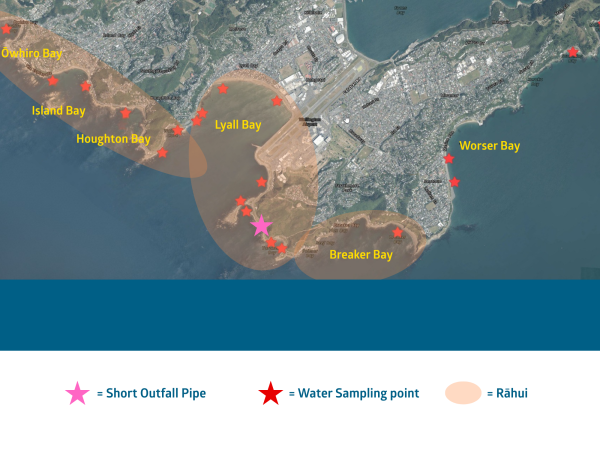
Update 2 - 7:30PM, 4 Feb
With power cut off at the plant and significant health and safety hazards present, it is unsafe for our teams to work onsite through the night.
Tomorrow morning, staff will be at the areas impacted by the wastewater discharge, distributing fliers to the local community.
- Out of an abundance of caution, the sampling area has been increased to stretch from Breaker Bay to Seatoun. While we understand the risk of wastewater reaching from Tarakena Bay around to Seatoun to be very low, we are erring on the side of caution and completing sampling at these sites every 24 hours. The rahui extends to Breaker Bay, and does not cover the area of coastline through to Seatoun. However, we note LAWAs existing advice following the recent heavy rain. LAWA advises to not swim for 2-3 days following heavy rain.
- This will be the final update for this evening. We’ll provide a brief update tomorrow morning, and a more fulsome update will be provided following tomorrow morning’s emergency management meeting at approximately 11:30am.
Update 1 - 4:30 PM, 4 Feb
Work continues at Moa Point Wastewater Treatment Plant, with all hands on deck to help with this issue. Teams will continue responding through the long weekend.
Our top priority is to protect public health and safety. Please be aware that untreated sewage poses a high risk to public health. Due to the ongoing discharge of untreated wastewater via the short outfall pipe’s discharge point at Tarakena Bay, we strongly advise that people avoid the coastal area along the south of Wellington until further notice. Do not enter the water or collect kaimoana from this area.
A rāhui has been placed from Ōwhiro Bay to Breaker Bay, and will remain in place until further notice. Signage is being placed around all impacted areas, and teams are continuing to door-knock local residents and businesses.
Sampling is occurring along the coast, and we are also assessing ocean currents to understand if wider sampling is needed.
We are working to ascertain the full impact of the flooding on the plant’s equipment and operations. This assessment will take some time, and we expect that this will be an extended outage at the plant. We are prioritising an investigation into diverting partially screened wastewater to the long outfall pipe. Discharging partially screened wastewater out to sea via the 1.8km long outfall pipe will allow for greater dilution of the wastewater in the Cook Strait, rather than untreated wastewater flowing around the coastline.
We have observed odour around the short outfall pipe’s discharge point. We are assessing options to mitigate odour in the short term, and protect the health and balance of the plant’s biological process to reduce the risk of any longer-term odour.
There are no impacts to the wider wastewater network or drinking water network. Drinking water remains safe to drink.
Please note that due to recent heavy rain, LAWA has designated areas around Wellington Harbour and the Eastern Bays in Lower Hutt as unsuitable for swimming. This is not related to the issue at Moa Point.
We’ll continue to keep you updated as work progresses.
Media release 11.10 AM, 4 Feb
Wellington Water is responding to a significant incident at the Moa Point Wastewater Treatment Plant which has resulted in untreated wastewater discharging into Tarakena Bay on the south coast.
The discharge, caused by equipment failure, started at 1am not 3am as previously reported and is still occurring. Wellington Water has set up an emergency management team and working at pace to stabilise the situation.
A duty manager investigated the plant following an alarm activation and FENZ alert.
The equipment failure has led to the plant needing to be shut down. All power at the plant has been shut off and staff have been evacuated from the site.
“Multiple floors and key areas of the plant have been inundated. This is a serious situation and we anticipate the plant will be shut down for an extended period of time,” says Wellington Water Chief Executive Pat Dougherty.
“Our immediate focus is restoring power to the plant, resuming service, and diverting wastewater to the long outfall pipe, which will improve dispersion and reduce impact on the coastline.
“We strongly advise the community to stay away from the south coast beaches. There is currently untreated wastewater being discharged into the water and this may occur for some time.
“Public health signage is being erected at Lyall Bay and the south coast beaches. We’re asking the public not to enter the water or collect kai moana. A rāhui will be placed over the affected area.
“We will have boots on the ground today, with our customer teams distributing information about public health and advice.
“An environmental team will be undertaking water quality testing. More information will be provided at lunchtime today. This is a complex incident and all necessary resources are being utilised.
“Wellington Water acknowledges that this is unacceptable and we apologise to the public, local community and our iwi partners for the public health and environmental impact caused,” says Pat.