
Published 6/02/2026
Results of water sampling following incident at Moa Point treatment plant
13 May update
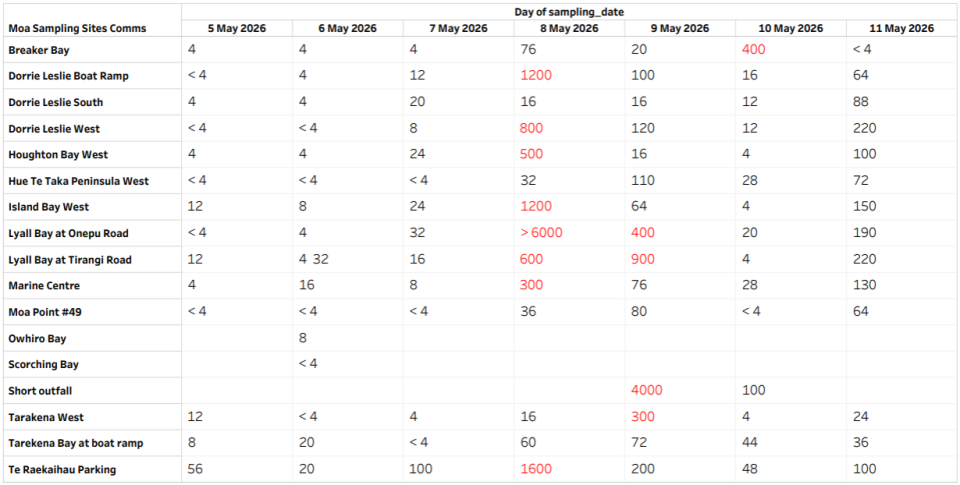
Please see below for water sampling results for 5 to 11 May.
Key points
- While the majority of sample sites had acceptable levels of bacteria across the week, we can see results related to rainfall and the use of the short outfall.
- We are continuing to monitor results to understand coastal trends over time.
6 May update
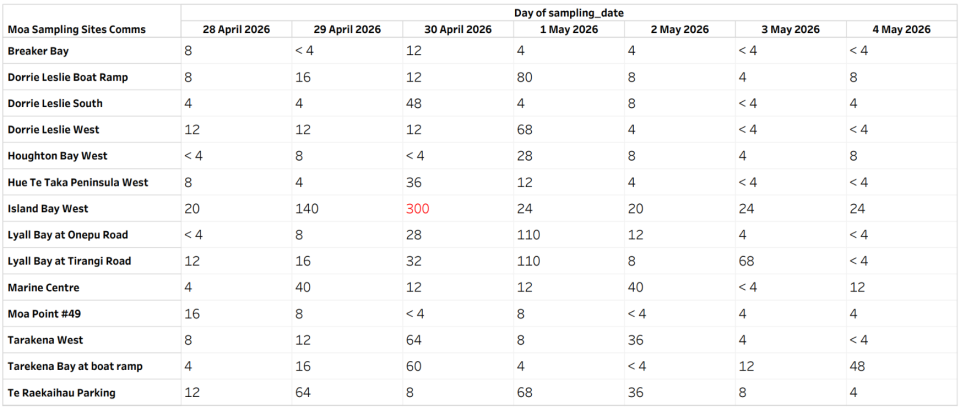
Please see below for water sampling results for 28 April to 4 May.
Key points
- This week’s water sample results show that the majority of sample sites had acceptable levels of bacteria across the week.
- Rain is the likely cause of the high result on 30 April at Island Bay West.
- We are continuing to monitor results to understand coastal trends.
29 April update
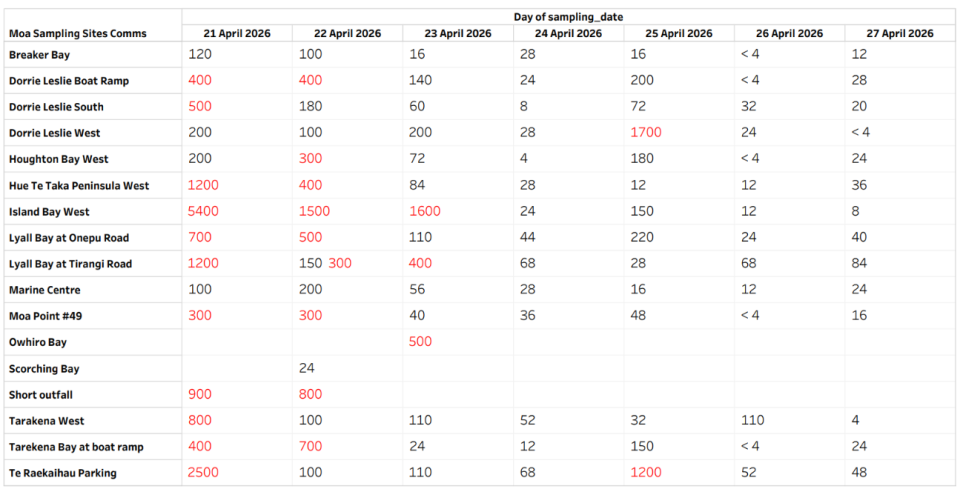
Please see below for the latest water sampling results.
Key points
-
The high levels in this weeks results are related to the intense wet weather experienced in Wellington recently, which results in increasing urban runoff and the short outfall being used between 20 and 22 April.
-
We are continuing to monitor results to understand coastal trends over time.
-
Please note that on 22 April there are two results shown under Lyall Bay at Tirangi Rd. These results are from two separate samples taken from the same site on the same day, at different times.
-
Results from 27 April have been delayed, and will be uploaded tomorrow morning (30 April).
An explanation of urban runoff can be found on LAWA's website.
22 April Update
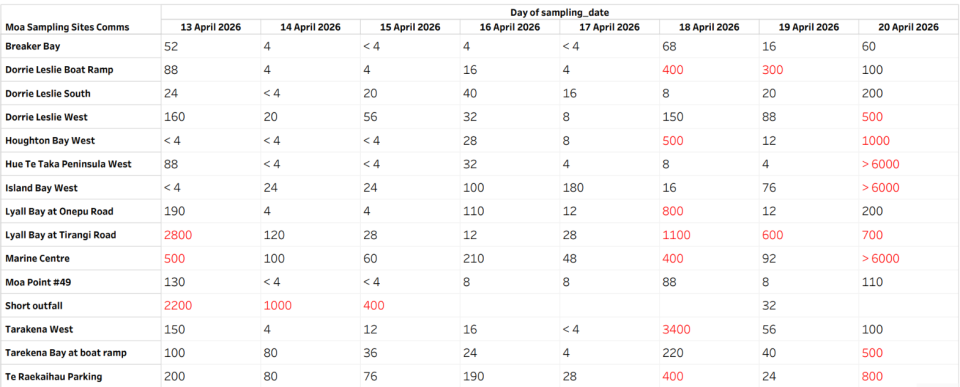
Wellington Water has released the results of water sampling for the week between 14 and 20 April around the Moa Point Wastewater Treatment Plant short outfall pipe and southern coast beaches.
Key points
-
While the majority of sample sites had acceptable levels of bacteria across the week, we can see results related to rainfall and the use of the short outfall. We are continuing to monitor results to understand coastal trends over time.
15 April update
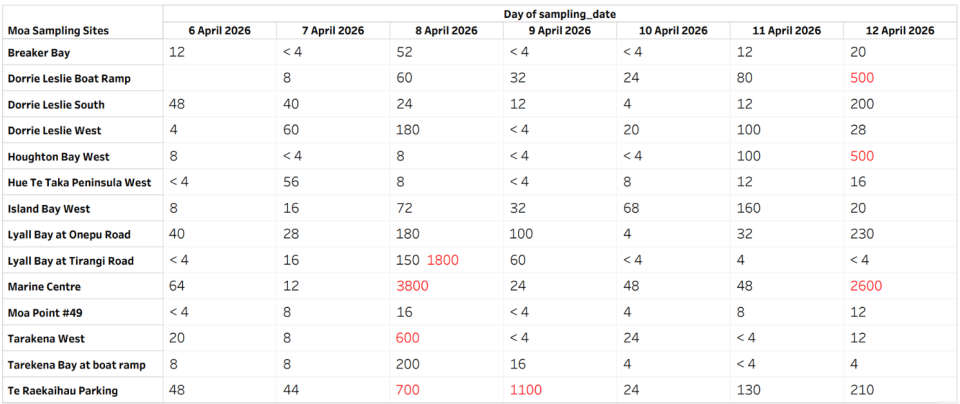
Wellington Water has released the results of water sampling for the week between 6 to 12 April around the Moa Point Wastewater Treatment Plant short outfall pipe and southern coast beaches.
Key points
-
These results were taken before the short outfall discharge on Sunday 12th April.
-
This week’s water sample results show that the majority of sample sites had acceptable levels of bacteria across the week. We are looking into the high results recorded on the 8th and 12th. Rain is the likely cause of the high result between these dates. We are continuing to monitor results to understand coastal trends.
-
Please note that on 8 April there are two results shown under Lyall Bay at Tirangi Rd. These results are from two separate samples taken from the same site on the same day, at different times.
8 April update
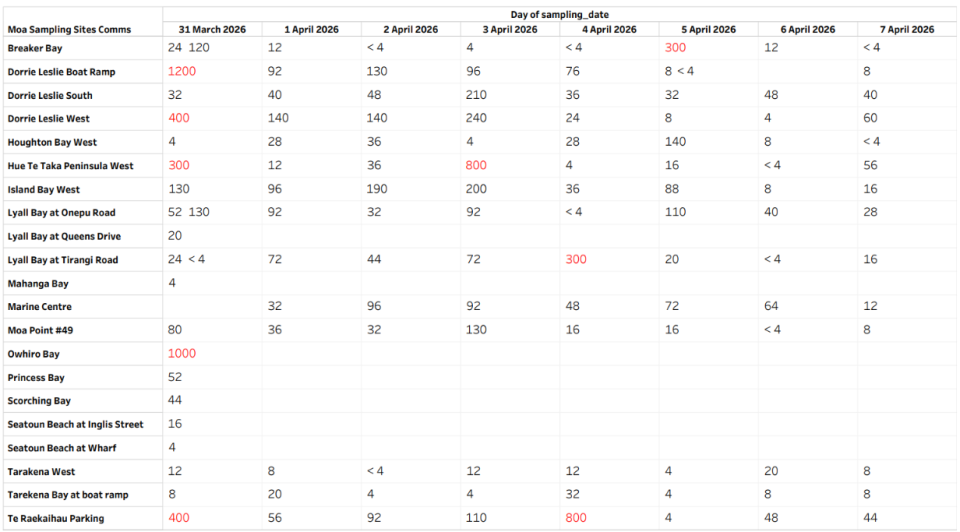
Wellington Water has released the results of water sampling for the week between 31 March to 4 April around the Moa Point Wastewater Treatment Plant short outfall pipe and southern coast beaches. There was an initial delay with the sampling results from 5 and 6 April. These have now been updated, along with the 7 April results.
Key points
-
This week’s water sample results show that the majority of sample sites had acceptable levels of bacteria across the week. The high results recorded on 31 March, 3 and 4 April have been noted, and we are continuing to monitor results to understand coastal trends moving forward.
-
Please note that on 31 March there are two results shown under Breaker Bay, Lyall Bay at Onepu Rd, and Lyall Bay at Tirangi Rd. These results are from two separate samples taken from the same site on the same day, at different times.
1 April update
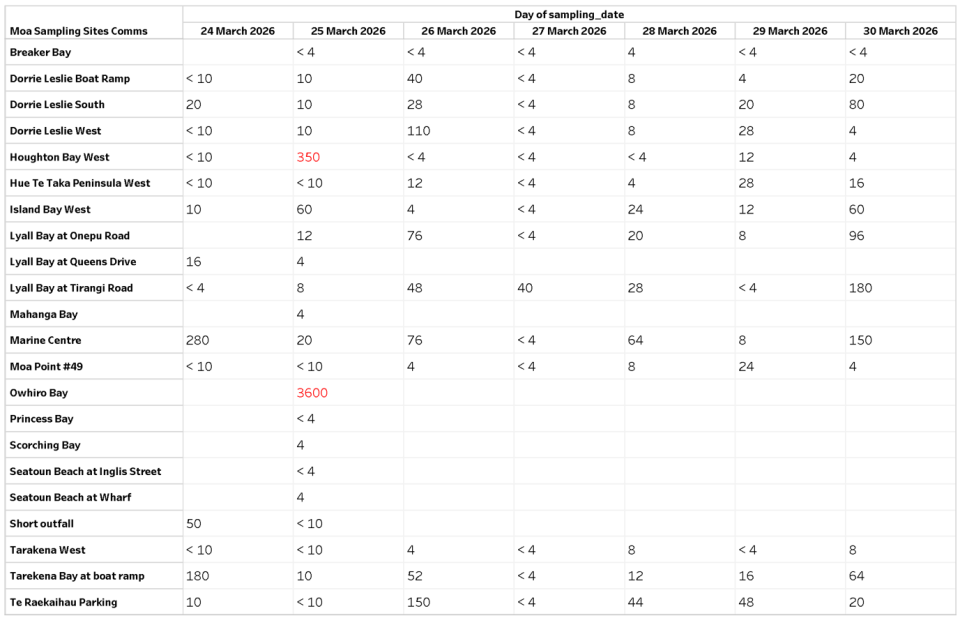
Wellington Water has released the results of water sampling for the week between 24 to 30 March around the Moa Point Wastewater Treatment Plant short outfall pipe and southern coast beaches.
Key points
-
This week’s water sample results show that most sample sites had acceptable levels of bacteria.
-
Elevated levels of enterococci detected at Ōwhiro Bay and Houghton Bay on March 25th reflect known ongoing freshwater quality issues unrelated to Moa Point. These sites are consistently monitored as part of our wider environmental monitoring programme. More information on Ōwhiro Bay can also be found at the LAWA website.
25 March update
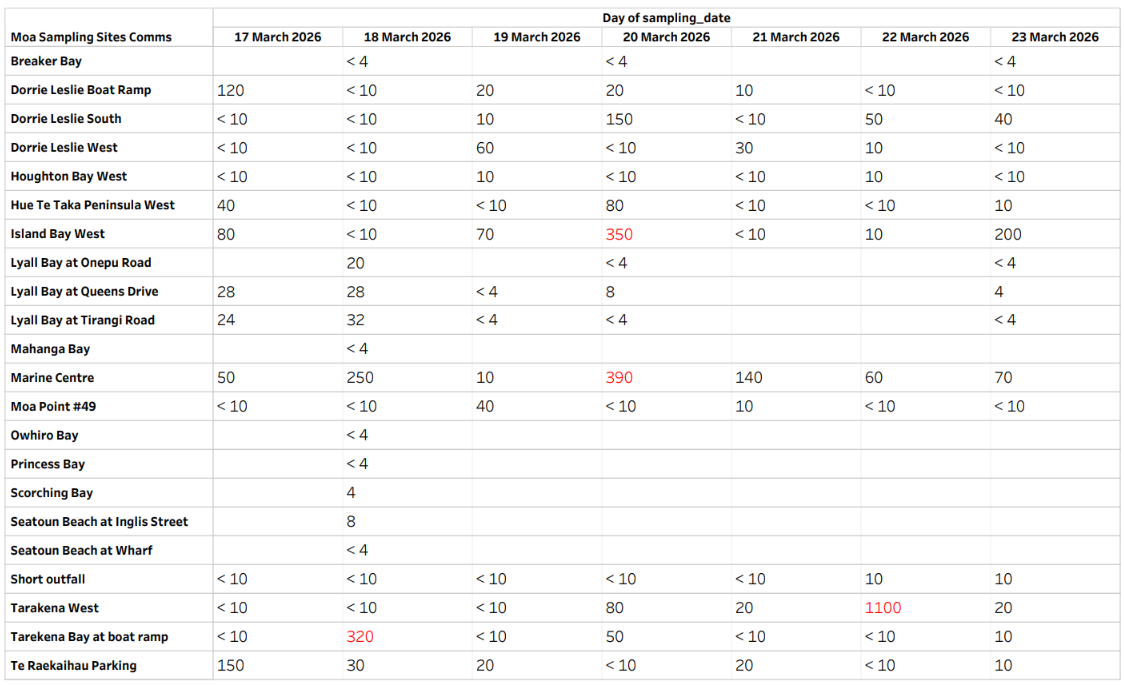
Wellington Water has released the results of water sampling for the week between 17 to 23 March around the Moa Point Wastewater Treatment Plant short outfall pipe and southern coast beaches.
Key points
-
This week’s water sample results show that most sample sites had acceptable levels of bacteria.
-
The high result recorded on March 22nd at Tarakena West has been noted, and the interagency group will be monitoring results from the coming days and weeks to understand if this relates to any trend. It is important to note that there has been no discharge out the short outfall.
18 March Update
Wellington Water has released the results of water sampling for the week between 9 to 16 March around the Moa Point Wastewater Treatment Plant short outfall pipe and southern coast beaches.
Key points
- Last Wednesday, we shared incorrect information about the frequency of water sample results being shared. A summary of the previous week’s water sample results will be published on our website each Wednesday.
- This week’s water sample results (reviewed by the interagency group including Wellington City Council, Greater Wellington Regional Council, National Public Health Service and Wellington Water) show that most sample sites had acceptable levels of bacteria.
- Higher levels were observed on three occasions, and these higher levels are likely due to do the rainfall experienced across these days.
Note on sample sites
- Since the announcement of the change in public health advice on 25 February, we made changes to the locations and frequencies of water sample sites.
- In our immediate response to the Moa Point incident, we sampled Wellington’s south coast and eastern bays from Mahanga to Ōwhiro Bay daily to build up a picture of the discharge’s impact on water around the south coast and surrounding area.
- Following this frequency of sampling, we found that overall, the water near the shore has been within the acceptable limits for safe swimming in dry weather conditions. Note that:
-
-
- Rainfall affects water quality, even if a site normally has very good weather conditions. LAWA's standard advice is to avoid swimming for 48hrs after rain.
- We are still developing our understanding of what happens during southerly conditions, but strong southerly winds have the potential to push contamination towards the shore.
-
-
- Our current water sampling schedule includes:
-
-
- Sites that are monitored daily because of their proximity to the long and short outfalls.
- Sites that are monitored three times per week because they are useful for continuing to build up a picture of what happens in certain weather conditions.
- Sites that are monitored weekly because they require less frequent oversight but are still important for understanding the situation.
-
-
- The sampling schedule has been designed to ensure we are targeting the right areas around the south coast and to give confidence in the quality of results.
- Regular sampling is also undertaken as part of Greater Wellington’s Recreational Water Quality Programme, and these results can be viewed on the LAWA website.
Public health advice
- The public health advice issued on 25 February remains in place. People can return to the beaches and swim near the shore in the area from Ōwhiro Bay to Breaker Bay in good weather conditions where LAWA indicates it is suitable.
- Tarakena Bay remains a no-go area due to its proximity to the short outfall pipe. The warning also remains to not collect kaimoana from Ōwhiro Bay to Breaker Bay.
- There are some areas and environmental conditions can also affect risk. Strong southerly winds may push contamination towards bays and closer to shore.
- The sample sites we have been testing have not included areas out in the Cook Strait near the long outfall pipe, so activities further from the shore such as surfing and diving may carry a higher exposure risk and should be conducted at people’s own risk.
- For further public health advice, including answers to frequently asked questions, please visit Health NZ’s website.
- To check whether it is safe to swim at any of the south coast beaches, please go to LAWA’s website.
Additional context
- Moa Point wastewater treatment plant continues to discharge screened, but untreated, wastewater into the environment via the long outfall pipe, and the short outfall, which isn’t screened, is likely to be used during rainfall. In the event the short outfall is used, LAWA remains the best source of information for safe swimming at beaches.
- There is no evidence to suggest the discharge from Moa Point Treatment Plant is reaching the inner harbour.
- The rāhui remains in place for Tarakena Bay.
11 March update
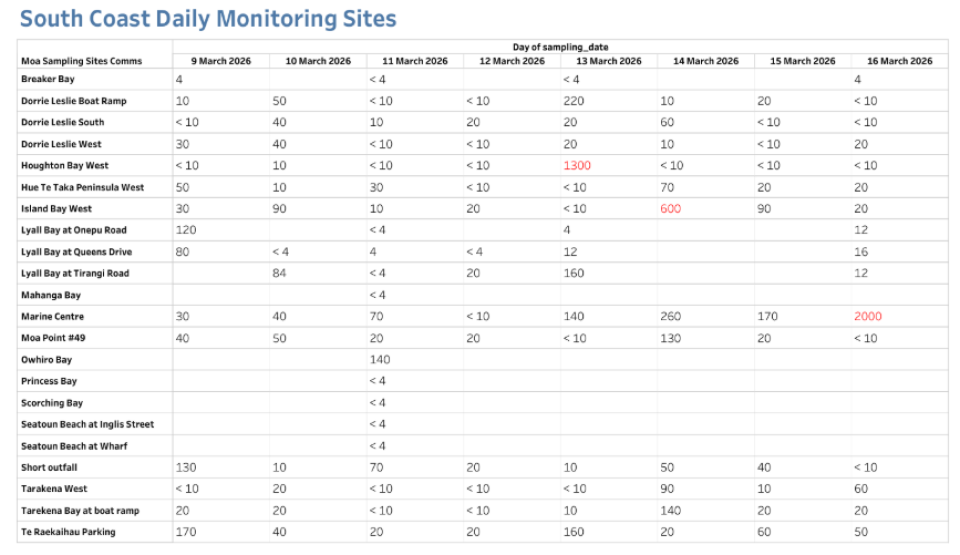
Wellington Water has released the results of water sampling for the week between 3 to 9 March around the Moa Point Wastewater Treatment Plant short outfall pipe and southern coast beaches.
Key points
- Last Wednesday, we shared our first weekly water sample summary. Please note that sampling results are published daily on the Wellington Water website, however the summary of results showing trends and explaining results will only take place each Wednesday moving forward.
- This week’s water sample results (reviewed by the interagency group including Wellington City Council, Greater Wellington Regional Council, National Public Health Service and Wellington Water) show that most sample sites had acceptable levels of bacteria.
- Higher levels were observed on the following dates and locations:
-
-
- 3 March – Dorrie Leslie Boat Ramp, Island Bay West, Island Bay Marine Centre and Lyall Bay at Tirangi Road.
- 4 March – Moa Point #49.
- 6 March – Island Bay West and Marine Centre Island Bay.
-
-
- These higher levels are likely due to do the rainfall experienced across these days.
Public health advice
- The public health advice issued on 25 February remains in place. People can return to the beaches and swim near the shore in the area from Ōwhiro Bay to Breaker Bay.
- Tarakena Bay remains a no-go area due to its proximity to the short outfall pipe. The warning also remains to not collect kaimoana from Ōwhiro Bay to Breaker Bay.
- There are some areas and environmental conditions can also affect risk. Strong southerly winds may push contamination towards bays and closer to shore.
- The sample sites we have been testing have not included areas out in the Cook Strait near the long outfall pipe, so activities further from the shore such as surfing and diving may carry a higher exposure risk and should be conducted at people’s own risk.
- For further public health advice, including answers to frequently asked questions, please visit Health NZ’s website.
- To check whether it is safe to swim at any of the south coast beaches, please go to LAWA’s website.
Additional context
- Moa Point wastewater treatment plant continues to discharge screened, but untreated, wastewater into the environment via the long outfall pipe, and the short outfall, which isn’t screened, is likely to be used during rainfall. In the event the short outfall is used, LAWA remains the best source of information for safe swimming at beaches.
- There is no evidence to suggest the discharge from Moa Point Treatment Plant is reaching the inner harbour.
- The rāhui remains in place for Tarakena Bay.
Our latest water sampling results

4 March update
Wellington Water has released the results of water sampling for the week between 23 February to 2 March around the Moa Point Wastewater Treatment Plant short outfall pipe and southern coast beaches.
Key points
- On 25 February we announced that the public health advice had changed and people could return to the beaches and swim near the shore in the area from Ōwhiro Bay to Breaker Bay. Tarakena Bay remains a no-go area due to its proximity to the short outfall pipe. This also means that no kaimoana can be collected from this area. The warning remains to not collect kaimoana from Ōwhiro Bay to Breaker Bay.
- The decision to allow people to return to the beaches and sea, came off the back of daily water sampling along the south coast. This gave us a good picture of what was happening and showed that overall, the water near the shore has been within the acceptable bacterial levels for safe swimming. After wet weather, LAWA’s standard advice to avoid the water for 48 hours remains.
- Based on the sampling results to date, the technical advice from the interagency group (Wellington City Council, Greater Wellington Regional Council, National Public Health Service and Wellington Water), is to focus on monitoring sites potentially impacted by the long outfall discharge and review trends.
- Following the discharge from Moa Point Wastewater Treatment Plant we sampled 23 sites on a daily basis.
- The changes made to the sampling schedule is as follows:
-
- We have reduced the total number of sample sites that we monitor from 23 to 14.
- Of those 14 sites, 12 will still be monitored daily and the remaining two will be done three times per week.
- In addition to these 14 sites, we also sample a range of recreational water sites for Greater Wellington as part of our business-as-usual work. These sites are displayed on the LAWA website, and weekly sampling results can be viewed by clicking on the “Why this status?” tab for a particular site. To support the Moa Point sampling, we have increased this from fortnightly to weekly.
- Note: The sampling sites and schedule is under constant review to ensure we are monitoring the appropriate sites and at the right frequency, based on technical advice, to develop a comprehensive picture of water quality impacts from the ongoing discharge.
-
- While the daily sampling and sharing of data was important in the emergency stages of our response, we are now in a more stable position with a growing dataset to build on. Therefore, the interagency group will now move to weekly meetings, and we will be publishing sampling results on a weekly basis.
- Sampling does not provide live data. It provides a snapshot of water conditions at the point in time they were taken (two days prior).
- We also can’t draw conclusions about the impact of varying weather conditions by reviewing individual daily sampling results. For this reason, we are now publishing results weekly to provide a more fulsome picture.
Notes on this week’s sample results
- Overall, the results from the past week show that most sample sites had acceptable levels of bacteria.
- Higher levels were observed on the following dates and locations:
-
- 24 February – Dorrie Leslie Park South, likely due to the long outfall discharge.
- 25 February – Tirangi Road. This is a site that we understand to be impacted by the nearby stormwater drain. This is not believed to be related to the long outfall discharge. Wellington Water are currently investigating this.
- 27 February – Island Bay West, Marine Centre Island Bay and Te Raekaihau Parking. Significant rainfall was recorded in the early hours of the morning.
- 2 March – Dorrie Leslie West and Te Raekaihau Parking. Rainfall also occured on this date.
-
- Note: where two results are shown, two sample results were taken on the same day at different times.
- There are some areas and conditions that present greater risk. For example, results over the past week show that in strong southerly conditions the western side of Te Raekaihau peninsula and western side of Island Bay tend to have higher levels of bacteria.
- The sample sites we have been testing have not included areas out in the Cook Strait near the long outfall pipe, so activities further from the shore such as surfing and diving should be conducted at people’s own risk.
Additional context
- Moa Point wastewater treatment plant continues to discharge screened, but untreated, wastewater into the environment via the long outfall pipe, and the short outfall, which isn’t screened, is likely to be used during rainfall. In the event the short outfall is used, LAWA remains the best source of information for safe swimming at beaches.
- There is no evidence to suggest the discharge from Moa Point Treatment Plant is reaching the inner harbour.
- The rāhui remains in place for Tarakena Bay.
- To check whether it is safe to swim at any of the south coast beaches, please go to LAWA’s website.
Our latest water sampling results

25 Feb update
Wellington Water has released the results of water sampling taken on Monday 23 February between 9am and 12pm, around the Moa Point Wastewater Treatment Plant short outfall pipe and southern coast beaches.
Moving forward, sampling updates will be provided weekly. The next sampling update will be released on Wednesday 4 March.
Key points
- We are continuing to sample for bacteria at various sites around the south coast and the harbour. Please note that the frequency of the testing is changing for some sites.
- Today, 25 February 2026, public health advice was changed. People can now go on the beaches and swim near the shore in the area from Ōwhiro bay to Breaker Bay. This excludes Tarakena Bay which remains a no-go area due to its proximity to the short outfall pipe. This also means that no kaimoana can be collected from this area.
- The sample sites we have been testing have not included areas out in the Cook Strait near the long outfall pipe, so activities further from the shore such as surfing and diving should be conducted at people’s own risk.
- To check whether it is safe to swim at any of the south coast beaches, please go to LAWA’s website. For public health advice, please go to Health NZ's health alerts.
- Wellington Water will continue to conduct water sampling at the new frequency and provide this information to the public as well as public health authorities to inform ongoing health advice as per usual.
Additional context:
- Moa Point wastewater treatment plant continues to discharge screened, but untreated, wastewater into the environment via the long outfall pipe, and the short outfall, which isn’t screened, is likely to be used during rainfall. In the event the short outfall is used, LAWA remains the best source of information for safe swimming at beaches.
- Our overall analysis of the water sampling results since the Moa Point discharge began indicates that, apart from the period around heavy rainfall and during the discharge of untreated water from the short outfall, bacteria levels have been within acceptable levels.
- There is no evidence to suggest the discharge from Moa Point Treatment Plant is reaching the inner harbour.
- Water sampling results are only one component used to assess the overall public health risk. Wellington Water is working with Wellington City Council, Greater Wellington Regional Council, Health NZ and technical experts to regularly review this guidance.
- The rāhui remains in place for Tarakena Bay.
23 Feb update
Wellington Water has released the results of water sampling taken on Saturday 21 February, between 9:06am and 11:11am, and Sunday 22nd February, between 7:52am and 10:29am, around the Moa Point Wastewater Treatment Plant short outfall pipe and southern coast beaches.
Key points
- Public health advice has not changed at this stage. People are advised to avoid swimming, diving, gathering or eating kaimoana along the south coast.
- Keeping people safe is our number one priority, and so public health officials recommend people follow the current advice to avoid getting sick.
- There are community concerns about sea spray on houses and other surfaces. Any contamination from sea spray is expected to pose a very low health risk because bugs that cause illness are diluted quickly in the environment and do not survive long on dry surfaces. UV in sunlight is a natural disinfectant.
- Testing of houses, cars, windows or soil is not currently recommended by public health, as it is not considered useful for assessing health risk.
- As bacteria are always present in the environment around us, the best protection is to wash and dry hands regularly, especially before preparing or eating food, and after outdoor activities.
- Wellington Water will continue to conduct water sampling and provide this information to the public as well as public health authorities to inform health advice.
Additional context
- Sampling provides a snapshot of water conditions. Results can vary significantly, even across samples taken in close proximity of time or location. That’s why we can’t draw conclusions about current conditions from one day’s data.
- Moa Point wastewater treatment plant continues to discharge screened, but untreated, wastewater into the environment via the long outfall pipe, and the short outfall, which isn’t screened, is likely to be used during rainfall.
- Water sampling results are only one component used to assess the overall public health risk. Wellington Water is working with Wellington City Council, Greater Wellington Regional Council, Health NZ and technical experts to regularly review this guidance.
- There is no evidence to suggest the discharge from Moa Point Treatment Plant is reaching the inner harbour.
- LAWA remains the best source of information for safe swimming at beaches outside the rāhui area.
21 Feb update
Wellington Water has released the results of water sampling taken on Friday 20 February, between 10:25am and 1pm, around the Moa Point Wastewater Treatment Plant short outfall pipe and southern coast beaches.
There will be a more substantive operational update on work being done at Moa Point on Monday morning.
Key points
- We are continuing to publish daily water sampling results from testing points around the south coast.
- Public health advice has not changed at this stage and is unlikely to change over the weekend.
- Keeping people safe is our number one priority, and so public health officials recommend people follow the current advice to avoid getting sick.
- Avoid swimming, diving, gathering or eating kaimoana along the south coast.
- Wellington Water will continue to conduct water sampling and provide this information to the public as well as public health authorities to inform health advice.
Additional context:
- Sampling provides a snapshot of water conditions. Results can vary significantly, even across samples taken in close proximity of time or location. That’s why we can’t draw conclusions about current conditions from one day’s data.
- Moa Point wastewater treatment plant continues to discharge screened, but untreated, wastewater into the environment via the long outfall pipe, and the short outfall, which isn’t screened, is likely to be used during rainfall.
- Water sampling results are only one component used to assess the overall public health risk. Wellington Water is working with Wellington City Council, Greater Wellington Regional Council, Health NZ and technical experts to regularly review this guidance.
- There is no evidence to suggest the discharge from Moa Point Treatment Plant is reaching the inner harbour.
- LAWA remains the best source of information for safe swimming at beaches outside the rāhui area.
20 Feb update
Wellington Water has released the results of water sampling taken on Wednesday 18 February, between 2:00pm and 4:30pm, around the Moa Point Wastewater Treatment Plant short outfall pipe and southern coast beaches.
Key points
- With the heavy rain past, and no usage of the short outfall, bacterial levels in the water have reduced again.
- The results over the past few days reaffirm why the standard public health advice is to avoid swimming for 48 hours after heavy rainfall across the whole harbour.
- Routine monitoring of other Wellington beaches displayed on LAWA that was undertaken on 17 February showed high levels of enterococcus across most beaches in the harbour. This is typical after heavy storms. For historical sampling results, visit www.lawa.org.nz and click on “Why this status?” for specific sites.
- Public health advice has not changed at this stage. People are advised to avoid swimming, diving, gathering or eating kaimoana along the south coast.
- Keeping people safe is our number one priority, and so public health officials recommend people follow the current advice to avoid getting sick.
- There are community concerns about sea spray on houses and other surfaces. Any contamination from sea spray is expected to pose a very low health risk because bugs that cause illness are diluted quickly in the environment and do not survive long on dry surfaces. UV in sunlight is a natural disinfectant.
- Testing of houses, cars, windows or soil is not currently recommended by public health, as it is not considered useful for assessing health risk.
- As bacteria are always present in the environment around us, the best protection is to wash and dry hands regularly, especially before preparing or eating food, and after outdoor activities.
- Wellington Water will continue to conduct water sampling and provide this information to the public as well as public health authorities to inform health advice.
Additional context
- Sampling provides a snapshot of water conditions. Results can vary significantly, even across samples taken in close proximity of time or location. That’s why we can’t draw conclusions about current conditions from one day’s data.
- Moa Point wastewater treatment plant continues to discharge screened, but untreated, wastewater into the environment via the long outfall pipe, and the short outfall, which isn’t screened, is likely to be used during rainfall.
- Water sampling results are only one component used to assess the overall public health risk. Wellington Water is working with Wellington City Council, Greater Wellington Regional Council, Health NZ and technical experts to regularly review this guidance.
- There is no evidence to suggest the discharge from Moa Point Treatment Plant is reaching the inner harbour.
- LAWA remains the best source of information for safe swimming at beaches outside the rāhui area.
18 Feb update
Wellington Water has released the results of water sampling taken on Tuesday 17 February, between 11.00am and 2.00pm, around the Moa Point Wastewater Treatment Plant short outfall pipe and southern coast beaches.
Key points
- As expected, due to the heavy rain in Wellinton on Monday 16 February, our most recent water sampling results (taken on Tuesday 17 February) show that Enterococcus (bacteria) levels have increased.
- Public health advice remains the same: it is strongly recommended for the public stay out of the water on the South coast of Wellington. Do not collect kai moana.
- We will continue to conduct water sampling and provide this information to the public as well as public health authorities to inform health advice.
*Sampling results have not been released since Tuesday 17 February. This is because sampling did not take place on Monday 16 February for health and safety reasons (with the recent storm passing). Sampling resumed Tuesday 17 February, with our sampling results published today.
Additional context:
- Sampling provides a snapshot of water conditions. Results can vary significantly even across samples taken in close proximity of time or location.
- That is why we cannot draw conclusions about current conditions from one day’s data.
- In addition, Moa Point wastewater treatment plant continues to discharge screened, but untreated, wastewater into the environment via the long outfall pipe.
- Given these factors, the risk to public health from swimming, surfing, boating or gathering and eating kai moana remains too unpredictable to change the current guidance.
- Water sampling results are only one component used to assess the overall public health risk. Wellington Water is working with Wellington City Council, Greater Wellington Regional Council, Health NZ and technical experts to regularly review this guidance.
- Keeping people safe is our number one priority, and so public health officials recommend people follow the current advice to avoid getting sick.
- There is no evidence to suggest the discharge from Moa Point Treatment Plant is reaching the inner harbour.
- LAWA remains the best source of information for safe swimming at beaches outside the rāhui area.
- Avoid swimming for at least 2-3 days after heavy or prolonged rain, even for sites that have good water quality.
17 Feb update
Wellington Water has released the results of water sampling taken on Sunday 15 February, between 8.30am and 11.00am, around the Moa Point Wastewater Treatment Plant short outfall pipe and southern coast beaches.
Key points for 17 February
Our most recent water sampling results (taken on Sunday, 15 February) show that Enterococcus (bacteria) levels remain relatively low overall, with one outlier located close to the short outfall.
There is no significant change from yesterday’s results.
Our advice remains the same: We strongly recommend the public stay out of the water on the South coast of Wellington. Do not collect kai moana.
Note: No sample results available for Moa Pt - #4 Houghton Bay West and Mahanga Bay, as sampling did not take place at these locations on Sunday, 15 February.
*Sampling results weren’t released on Wednesday 18 February. This is because sampling did not take place on Monday, 16 February for health and safety reasons (with the recent storm passing). Sampling resumed Tuesday 17 February, with sampling results published on Thursday 19 February.
Additional context:
- Sampling provides a snapshot of water conditions. Results can vary significantly even across samples taken in close proximity of time or location.
- That is why we cannot draw conclusions about current conditions from one day’s data.
- In addition, Moa Point wastewater treatment plant continues to discharge screened, but untreated, wastewater into the environment via the long outfall pipe.
- Given these factors, the risk to public health from swimming, surfing, boating or gathering and eating kai moana remains too unpredictable to change the current guidance.
- Water sampling results are only one component used to assess the overall public health risk. Wellington Water is working with Wellington City Council, Greater Wellington Regional Council, Health NZ and technical experts to regularly review this guidance.
- Keeping people safe is our number one priority, and so public health officials recommend people follow the current advice to avoid getting sick.
- There is no evidence to suggest the discharge from Moa Point Treatment Plant is reaching the inner harbour.
- LAWA remains the best source of information for safe swimming at beaches outside the rāhui area.
- Avoid swimming for at least 2-3 days after heavy or prolonged rain, even for sites that have good water quality.
16 Feb update
Wellington Water has released the results of water sampling taken on Saturday 14 February, between 8.00am and 11.20am, around the Moa Point Wastewater Treatment Plant short outfall pipe and southern coast beaches.
Sampling will not be taking place today due to the health and safety risk however this will recommence when possible.
We will continue to sample and publish results until further notice.
Key points for 16 February
- Discharge from the short outfall bypasses the screening process, meaning the discharge would include solid material such as wipes and period products. It would also mean wastewater is entering the ocean much closer to shore.
- The combination of rain and strong southerly winds may increase the likelihood of untreated wastewater being pushed towards the shoreline.
- As expected, due to the weather conditions, we are starting to see some high levels of Enterococcus (bacteria) in the sampling results.
- Rain effects the water quality across all of Wellington due to discharge from the rivers which are affected by pollutants from rural and urban run-off.
- Frequently asked questions regarding sea spray have been answered by public health officials, and are available on our website please scroll down to the Public Health FAQs section.
- The sampling results from Sunday 15 February will be available Tuesday 17 February, these will provide more information regarding any changes which may have taken place due to the weather.
- Please note, Owhiro Bay sampling results are not related to the Moa Point discharge incident. These elevated levels reflect ongoing variable quality in the Owhiro Stream, please refer to existing warning on LAWA website.
- Testing for harmful bacteria in seawater takes time. Samples have to be grown in a laboratory for a minimum of 24 hours in order to be accurately measured, and those results need to be reviewed so they are as reliable as possible to inform decisions about public health.
- Sampling provides a snapshot of water conditions. Results can vary significantly even across samples taken in close proximity of time or location.
- That is why we cannot draw conclusions about current conditions from one day’s data.
- In addition, Moa Point wastewater treatment plant continues to discharge screened, but untreated, wastewater into the environment via the long outfall pipe.
- Given these factors, the risk to public health from swimming, surfing, boating or gathering and eating kai moana remains too unpredictable to change the current guidance.
- Water sampling results are only one component used to assess the overall public health risk. Wellington Water is working with Wellington City Council, Greater Wellington Regional Council, Health NZ and technical experts to regularly review this guidance.
- Keeping people safe is our number one priority, and so public health officials recommend people follow the current advice to avoid getting sick.
- There is no evidence to suggest the discharge from Moa Point Treatment Plant is reaching the inner harbour.
- LAWA remains the best source of information for safe swimming at beaches outside the rāhui area.
- Avoid swimming for at least 2-3 days after heavy or prolonged rain, even for sites that have good water quality.
15 Feb update
Wellington Water provide sampling results to Regional Public Health and Greater Wellington, who are responsible for public health and water quality guidance. These results were taken on Friday 13 February, between 10am and 1.15pm, around the Moa Point Wastewater Treatment Plant short outfall pipe and southern coast beaches.
Wellington Water will continue to sample and publish results daily until further notice.
Key points for 15 February
- As expected, due to the weather conditions, we are starting to see some high levels of Enterococcus (bacteria) in the sampling results
- Rain affects the water quality across all of Wellington.
- Due to the effects rain has on coastal areas, please continue to follow the advice from LAWA to not swim for two days following rainfall.
- The incoming weather is creating some concern due to the combination of rain and strong southerly winds which may increase the likelihood of untreated wastewater being pushed towards the shoreline.
- Refer to the public health frequently asked questions on our website, provided by public health officials, if you have any concerns regarding sea spray.
- We are watching the next few days’ sampling results to better understand the effects from the weather.
- The sampling results from Sunday 15 February will be available Tuesday 17 February; these will provide more information regarding any changes which may have taken place due to the weather.
- Due to the effects rain has on coastal areas, please continue to follow the advice from LAWA to not swim for two days following rainfall.
- Please note, Owhiro Bay sampling results are not related to the Moa Point discharge incident. These elevated levels reflect ongoing variable quality in the Owhiro Stream, please refer to existing warning on LAWA website.
- Testing for harmful bacteria in seawater takes time. Samples are grown in a laboratory for a minimum of 24 hours in order to be accurately measured, and those results need to be reviewed so they are as reliable as possible to inform decisions about public health.
- Sampling provides a snapshot of water conditions. Results can vary significantly even across samples taken in proximity of time or location.
- That is why we cannot draw conclusions about current conditions from one day’s data.
- Heavy rainfall is likely to lead to some wastewater flow from the short outfall. This would bypass the screening process, meaning the discharge would include solid material such as wipes and period products. It would also mean wastewater is entering the ocean much closer to shore.
14 Feb update
Wellington Water has released the results of water sampling taken on Thursday 12 February, between 9.30am and 1.00pm, around the Moa Point Wastewater Treatment Plant short outfall pipe and southern coast beaches.
There has been no discharge from the short outfall pipe since 9pm, Thursday 5 February.
We will continue to sample and publish results daily until further notice.
- The incoming weather is creating some concern due to the combination of rain and strong southerly winds which may increase the likelihood of untreated wastewater being pushed towards the shoreline.
- Refer to the public health frequently asked questions if you have any concerns regarding sea spray.
- We are watching the next few days sampling results to better understand the effects from the weather.
- The sampling results from Saturday 14 February will be available Monday 16 February, these will provide more information regarding any changes which may have taken place due to the weather.
- Due to the effects rain has on coastal areas, please continue to follow the advice from LAWA to not swim for two days following rain fall.
- Please note, Owhiro Bay sampling results are not related to the Moa Point discharge incident. These elevated levels reflect ongoing variable quality in the Owhiro Stream, please refer to existing warning on LAWA website.
- Testing for harmful bacteria in seawater takes time. Samples have to be grown in a laboratory for a minimum of 24 hours in order to be accurately measured, and those results need to be reviewed so they are as reliable as possible to inform decisions about public health.
- Sampling provides a snapshot of water conditions. Results may vary significantly even across samples taken in close proximity of time or location.
- That is why we cannot draw conclusions about current conditions from one day’s data.
- In addition, Moa Point wastewater treatment plant continues to discharge screened, but untreated, wastewater into the environment via the long outfall pipe.
- Rainfall is forecast over the weekend, which may is likely to result in a discharge from the short outfall. This would bypass the screening process, meaning the discharge would include solid material such as wipes and period products. It would also mean wastewater is entering the ocean much closer to shore.
- Given these factors, the risk to public health from swimming, surfing, boating or gathering and eating kai moana remains too unpredictable to change the current guidance.
- Water sampling results are only one component used to assess the overall public health risk. Wellington Water is working with Wellington City Council, Greater Wellington Regional Council, Health NZ and technical experts to regularly review this guidance.
- Keeping people safe is our number one priority, and so public health officials recommend people follow the current advice to avoid getting sick.
- There is no evidence to suggest the discharge from Moa Point Treatment Plant is reaching the inner harbour.
- LAWA remains the best source of information for safe swimming at beaches outside the rāhui area.
13 Feb update
Wellington Water has released the results of water sampling taken on Wednesday 11 February, between 10.00am and 1.30pm, around the Moa Point Wastewater Treatment Plant short outfall pipe and southern coast beaches.
There has been no discharge from the short outfall pipe since 9pm, Thursday 5 February.
We will continue to sample and publish results daily until further notice.
Key points for 13 February
- The incoming weather is creating some concern due to the combination of rain and strong southerly winds which could significantly increase the likelihood of untreated wastewater being pushed towards the shoreline.
- We are watching the next few days sampling results to better understand the effects from the weather.
- The sampling results from Friday 13 February will be available Sunday 15 February, these will provide more information regarding any changes which may have taken place due to the weather.
- Due to the effects rain has on coastal areas, please continue to follow the advice from LAWA to not swim for two days following rain fall.
- Please note, Owhiro Bay sampling results are not related to the Moa Point discharge incident. These elevated levels reflect ongoing variable quality in the Owhiro Stream, please refer to existing warning on LAWA website.
- Testing for harmful bacteria in seawater takes time. Samples have to be grown in a laboratory for a minimum of 24 hours in order to be accurately measured, and those results need to be reviewed so they are as reliable as possible to inform decisions about public health.
- Sampling provides a snapshot of water conditions. Results can vary significantly even across samples taken in close proximity of time or location.
- That is why we cannot draw conclusions about current conditions from one day’s data.
- In addition, Moa Point wastewater treatment plant continues to discharge screened, but untreated, wastewater into the environment via the long outfall pipe.
- Rainfall is forecast over the weekend, which is likely to result in a discharge from the short outfall. This would bypass the screening process, meaning the discharge would include solid material such as wipes and period products. It would also mean wastewater is entering the ocean much closer to shore.
- Given these factors, the risk to public health from swimming, surfing, boating or gathering and eating kai moana remains too unpredictable to change the current guidance.
- Water sampling results are only one component used to assess the overall public health risk. Wellington Water is working with Wellington City Council, Greater Wellington Regional Council, Health NZ and technical experts to regularly review this guidance.
- Keeping people safe is our number one priority, and so public health officials recommend people follow the current advice to avoid getting sick.
- There is no evidence to suggest the discharge from Moa Point Treatment Plant is reaching the inner harbour.
- LAWA remains the best source of information for safe swimming at beaches outside the rāhui area.
12 Feb update
Wellington Water has released the results of water sampling taken on Tuesday 10 February, between 9:30am and 1pm, around the Moa Point Wastewater Treatment Plant short outfall pipe and southern coast beaches.
There has been no discharge from the short outfall pipe since 9pm, Thursday 5 February.
We will continue to sample and publish results daily until further notice.
Key points for 12 February
-
Testing for harmful bacteria in seawater takes time. Samples have to be grown in a laboratory for a minimum of 24 hours in order to be accurately measured, and those results need to be reviewed so they are as reliable as possible to inform decisions about public health.
-
Sampling provides a snapshot of water conditions. Results can vary significantly even across samples taken in close proximity of time or location.
-
That is why we cannot draw conclusions about current conditions from one day’s data.
-
In addition, Moa Point wastewater treatment plant continues to discharge screened, but untreated, wastewater into the environment via the long outfall pipe.
-
Rainfall is forecast over the weekend, which is likely to result in a discharge from the short outfall. This would bypass the screening process, meaning the discharge would include solid material such as wipes and period products. It would also mean wastewater is entering the ocean much closer to shore.
-
Given these factors, the risk to public health from swimming, surfing, boating or gathering and eating kai moana remains too unpredictable to change the current guidance.
-
Water sampling results are only one component used to assess the overall public health risk. Wellington Water is working with Wellington City Council, Greater Wellington Regional Council, Health NZ and technical experts to regularly review this guidance.
-
Keeping people safe is our number one priority, and so public health officials recommend people follow the current advice to avoid getting sick.
-
There is no evidence to suggest the discharge from Moa Point Treatment Plant is reaching the inner harbour.
-
LAWA remains the best source of information for safe swimming at beaches outside the rāhui area.
11 Feb update
Wellington Water has released the results of water sampling taken on Monday 9 February, between 10:30am and 2:00pm, around the Moa Point Wastewater Treatment Plant short outfall pipe and southern coast beaches.
There has been no discharge from the short outfall pipe since 9pm, Thursday 5 February.
We will continue to sample and publish results daily until further notice.
Key points for 11 February
- Please note, the Owhiro Bay sampling results are not related to the Moa Point discharge incident. These results reflect the ongoing contamination in the Owhiro Stream and low tide sample.
- Rainfall is forecast for the end of this week, which is likely to result in a discharge from the short outfall.
- Public health officials strongly advise against gathering shellfish or kai moana on the south coast beaches. Shellfish remain contaminated for weeks after exposure to wastewater.
- Public health officials continue to caution people against visiting the south coast beaches, swimming, kayaking, or otherwise coming into contact with sea water or spray.
- Water sampling results are only one component used to assess the overall public health risk. Wellington Water is working with Wellington City Council, Greater Wellington Regional Council, Health NZ and technical experts to regularly review this guidance.
- Tides, rain and other weather conditions can all significantly impact the results, and changes can occur quickly. The weather conditions over the past week (no rain and absence of a strong southerly) were very favourable in terms of limiting the impact of the discharge outside the immediately affected area.
- While Moa Point Wastewater Treatment Plant continues to discharge untreated wastewater to the ocean, and there is a high probability of the short outfall being used in wet weather, the risk to public health remains high.
- There is no evidence to suggest the discharge from Moa Point Treatment Plant is reaching the inner harbour.
- LAWA remains the best source of information for safe swimming at beaches outside the rāhui area.
10 Feb update
Wellington Water has released the results of water sampling taken on Sunday 8 February, between 10:30am and 2:00pm, around the Moa Point treatment plant short outfall pipe and southern coast beaches.
There has been no discharge from the short outfall pipe since 9pm, Thursday 5 February.
We will continue to sample and publish results daily until further notice.
Key points for 10 February
- Results indicate that the untreated wastewater initially discharged from the short outfall has dispersed from the area around Tarakena Bay.
- Rainfall is forecast for the end of this week, which is likely to result in a discharge from the short outfall.
- Public health officials strongly advise against gathering shellfish or kai moana on the south coast beaches. Shellfish remain contaminated for weeks after exposure to wastewater.
- Public health officials continue to caution people against visiting the south coast beaches, swimming, kayaking, or otherwise coming into contact with sea water or spray.
- Water sampling results are only one component used to assess the overall public health risk. Wellington Water is working with Wellington City Council, Greater Wellington Regional Council, Health NZ and technical experts to regularly review this guidance.
- Tides, rain and other weather conditions can all significantly impact the results, and changes can occur quickly. The weather conditions over the past week (no rain and absence of a strong southerly) were very favourable in terms of limiting the impact of the discharge outside the immediately affected area.
- While Moa Point Treatment Plant continues to discharge untreated wastewater to the ocean, and there is a high probability of the short outfall being used in wet weather, the risk to public health remains high.
- There is no evidence to suggest the discharge from Moa Point Treatment Plant is reaching the inner harbour.
- LAWA remains the best source of information for safe swimming at beaches outside the rāhui area.
9 Feb update
Wellington Water has released the results of water sampling taken on Saturday 7 February, between 9:30am and 2:00pm, around the Moa Point treatment plant short outfall pipe and southern coast beaches.
These samples were taken while the tide was going out and in stable weather conditions, which impacts the results.
There was no discharge from the short outfall pipe at this time.
We will continue to sample and publish results daily until further notice.
Key points for 9 February
- Results remain consistent across the weekend with localised evidence of contamination at south coast beaches, except for the area immediately surrounding the short outfall pipe.
- There is no evidence to suggest the discharge from Moa Point Treatment Plant is reaching the inner harbour.
- Test results are one component in assessing the overall public health risk. Expert opinions and other factors are included in the decision making process.
- As long as Moa Point Treatment Plant is discharging untreated wastewater into the ocean, and there is a high probability of the short outfall being used in wet weather, the risk to public health remains high.
- Public health officials continue to advise people to stay off south coast beaches, not to collect or eat shellfish / kai moana from the affected coastal waters, avoid the area around Tarakena Bay altogether, and avoid contact with sea water or spray.
- LAWA remains the best source of information for safe swimming at beaches outside the rāhui area.
8 Feb update
Wellington Water has released the results of water sampling taken on Friday 6 February, between 9am and 1pm, around the Moa Point treatment plant short outfall pipe and southern coast beaches.
These samples were taken while the tide was going out and in stable weather conditions, which impacts the results.
There was no discharge from the short outfall pipe at this time.
We will continue to sample and publish results daily until further notice.
-
While these results look promising, they represent a snapshot from two days ago. There is still screened, but untreated, wastewater discharging into the ocean and conditions on Wellington’s coast can change rapidly. The risk to public health remains high until we have more certainty about when the treatment process will be restarted.
-
The rāhui placed by mana whenua remains in effect from Ōwhiro Bay to Breaker Bay. This reflects concern for the safety of people and giving the natural environment breathing space.
-
Public health officials continue to advise people to stay off south coast beaches, not to collect or eat shellfish / kai moana from the affected coastal waters, avoid the area around Tarakena Bay altogether, and avoid contact with sea water or spray.
-
Test results are one component in assessing the overall public health risk. Expert opinions and other factors are included in the decision making process.
-
LAWA remains the best source of information for safe swimming at beaches outside the rāhui area.
7 Feb update
- As expected, we are continuing to see high results from sampling areas close to the short outfall pipe, which was still discharging at the time the samples were taken.
- There is no indication from these results that untreated wastewater from Moa Point had reached the inner harbour (Eastbourne, Petone, CBD, Kilbirnie) at the time these samples were taken. We do not believe there is any need to extend the sampling area at this time.
- Ōwhiro Bay and Mahanga Bay have returned to low levels of contamination, confirming that the previous results were more likely connected with rain events
- For guidance on beaches outside this area, please see the LAWA website.
- We are reporting levels of enterococcus only, as these are the most reliable indicator of recent faecal contamination and correlate best with human health risks.
- We want to emphasise that these results are a snapshot, and do not reflect current conditions. Bacterial conditions in seawater can change rapidly depending on tide, wind, rain and other factors.
- The warning for south coast beaches includes avoiding water sports such as kayaking, boating, and parasailing. Exposure to wet gear and contaminated sea spray can pose a risk to health.
6 Feb Update
Key points - 6 Feb
-
These samples were taken on Wednesday 4 February and do not reflect the current conditions.
-
Three sampling locations returned levels of enterococcus above the guideline for safe swimming. While 15 samples returned results under the Ministry for the Environment and Ministry of Health’s threshold levels, this does not mean it is safe to swim and formal public health advice remains to keep out of the water, avoid the beach and do not collect kaimoana.
-
The results from Hue Te Taka Peninsula are many times over the safe limit.
-
Moa Point is continuing to discharge untreated wastewater. Untreated wastewater poses a high risk to public health.
-
Due to the ongoing issues avoid the coastal area along the south of Wellington until further notice.
-
Please do not swim, dive, fish, gather kaimoana, walk dogs or access the shoreline until further notice.
-
A rāhui remains in place between Ōwhiro Bay and Breaker Bay.
Information on water sampling
-
Samples were collected by Eurofins, an independent accredited laboratory, between 4pm and 7pm on Wednesday 4 February for the first time.
-
Sampling results can be influenced by factors including wind, tide, and rainfall.
-
There is a delay in reporting the results of water samples because the bacteria needs to be given 24 hours to grow in laboratory conditions so it can be counted. The results then need to be finalised to provide the most accurate data.
-
The results from Wednesday cover 18 sampling sites, from Ōwhiro Bay to Mahanga Bay. More sites will be reported in future updates.
-
Enterococci are used by the Ministry for the Environment (MfE) to monitor marine water quality because they are the most reliable indicator of recent faecal contamination and correlate best with human health risks (gastroenteritis, ear/skin infections) in saline water. Unlike other indicators, enterococci survive longer in saltwater, are easy to test for, and accurately signal the presence of sewage or animal runoff. For more information read the Guidelines for marine and freshwater recreational areas on the Ministry of Environment website.
-
The Ministry for the Environment and Ministry of Health threshold for determining if water is unsafe for swimming is 280cfu/100ml for entercoccus bacteria. More information on sampling is available from LAWA.
-
We are not able to draw any conclusions about the level of contamination or environmental impacts of the discharge from one set of samples. We will be conducting daily sampling and reviewing the results over several days to inform our response.
-
These results were taken before the long outfall pipe was able to be brought back online overnight.
-
We intend to publish daily reports on the water sampling results.
-
Wellington Water is working closely with Greater Wellington Regional Council and the National Public Health Service to monitor the situation and manage risks to health and public safety.
Analysis of results
-
Three sites returned elevated levels of enterococcus and faecal coliforms, above the safe swimming limit.
-
While 15 samples returned results under the Ministry for the Environment and Ministry of Health’s threshold levels, this does not mean it is safe to swim, and formal public health advice remains to keep out of the water, avoid the beach and do not collect kaimoana. A rāhui remains in place between Ōwhiro Bay and Breaker Bay.
-
The result from Hue Te Taka peninsula, which is very close to the short outfall, is many times over the safe swimming limit and shows where the contaminated water was at that time
-
The results on Wed 4 Feb from Mahanga Bay and Ōwhiro Bay are considered to be outliers and caused by the rainfall earlier in the week, not the discharge from Moa Point.
-
Members of the public have asked whether the discharge from Moa Point has reached the inner harbour and whether sampling should be done there. The discoloration in the inner harbour this week is very typical of rain and stormwater runoff being discharged by the Hutt River.
-
We will continue to sample around the eastern bays (Scorching Bay and Mahanga Bay) to confirm that there is no indication of the discharge impacting the inner harbour.
-
Go to LAWA for more information on faecal indicators in water testing.